Semana Santa in Seville: How to Experience Holy Week Without the Chaos
How to experience Semana Santa in Seville as a visitor — the best processions, where to stand, what to book and what to skip. Practical 2026 guide.
Seville's Holy Week is the largest religious street festival in the world. That's not hyperbole — it's logistics. Over a million visitors pour into a city of 690,000 people across seven days in spring, and the entire street plan effectively shuts down for processions that can last twelve hours. If you just turn up with a hotel booking and good intentions, you'll spend most of it lost behind a crush of people, unable to see anything, eating a mediocre bocadillo from an overpriced stall.
How to experience Semana Santa in Seville as a visitor, done properly: arrive a day before Palm Sunday, pick three or four specific processions rather than trying to see everything, learn the difference between a paso and a costalero, and book a spot on a palco (grandstand) or a balcony rental for at least one evening. That's the skeleton. The rest is timing, geography and knowing when to walk away.
What Semana Santa Actually Is
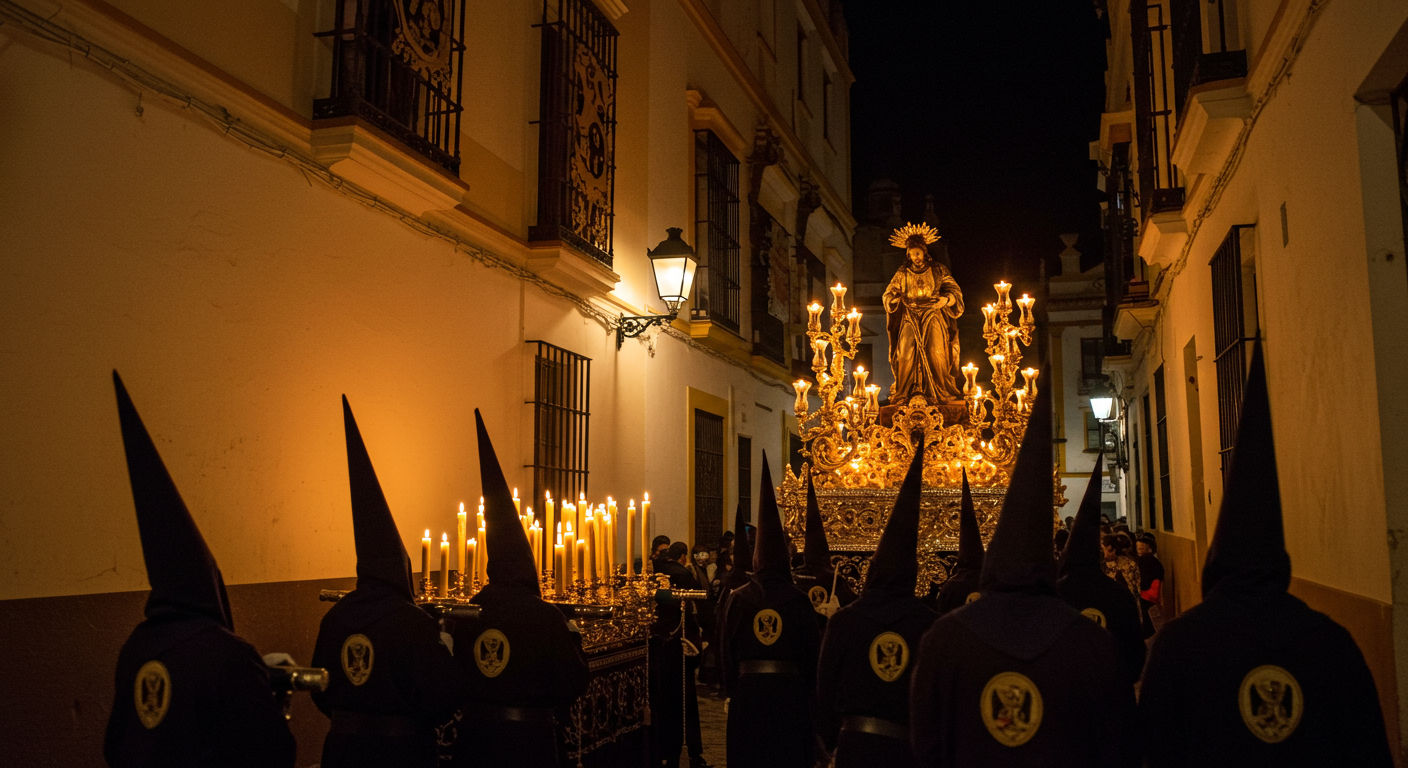
It runs from Palm Sunday to Easter Sunday — in 2026, that's 29 March to 5 April. Each of the sixty-odd hermandades (brotherhoods, some of them centuries old) processes through the city on an assigned day, carrying enormous sculptural floats called pasos: one bearing a scene from the Passion, one bearing the Virgin. The bearers, costaleros, carry these on their necks and shoulders from inside the float — completely invisible to the crowd — guided by a capataz who knocks a wooden signal on the underside. A good procession can have two hundred or more costaleros underneath a single paso, and the float weighs several tonnes.
The nazarenos — penitents in the tall conical hoods that have startled many an uninitiated tourist — walk in long, slow columns ahead of and behind the pasos. The hoods are capirotes; the robes are túnicas. Children throw sweets from the floats. Someone in the crowd might break into a saeta — an improvised flamenco lament sung directly at the Virgin as she passes. The procession stops. The crowd goes silent. Then it moves on.
This is not a performance for tourists. It is a deeply felt religious and civic event. That context matters for how you behave and what you get out of it.
When to Go and How Long You Need
You need at least four nights, ideally five or six. Arriving for just the weekend is a waste of money — Easter Sunday itself is actually one of the quieter days, and the crowds peak on Holy Thursday and Good Friday. The most celebrated processions are those of La Madrugá (the small hours of Good Friday morning), when six of the most important brotherhoods process through the night. People stay up until four or five in the morning for this. It is genuinely extraordinary.
If you can only pick one night, make it Madrugá. If you can pick two, add Holy Wednesday, when the city is slightly less packed and several beautiful brotherhoods process in the late afternoon and evening.
Palm Sunday is worth seeing for the La Borriquita brotherhood — the entry into Jerusalem — which processes with children and has a different, lighter atmosphere. It's a good first day to get your bearings.
The Geography: Where to Watch
Every procession follows its own route, but all of them pass through the carrera oficial — the official route along Calle Campana, Calle Sierpes, Plaza de San Francisco and the Cathedral. This stretch is grandstand territory: palcos are installed here for the week, and seats are sold months in advance. Expect to pay €30–€80 per seat depending on the night and the section, as of 2026. They sell out. Check the Ayuntamiento de Sevilla's official site in January.
If you don't have a grandstand seat, the carrera oficial is still watchable but you'll be standing in a tight crowd. Get there ninety minutes before the procession is timed to pass. The processions are always late — sometimes by an hour or more — so bring patience and something to eat.
The better strategy for most visitors is to watch outside the official route, in the neighbourhoods where the brotherhoods originate. Triana is excellent for this: the brotherhoods from across the river cross the Puente de Triana, and you can watch them process along Calle Betis with far more breathing room. The atmosphere is local and emotional — residents hang from balconies, neighbours greet each other, the paso sways past at eye level.
Similarly, La Macarena neighbourhood for the brotherhood of the same name, and the streets around El Salvador church are worth knowing. These are the moments that feel real rather than managed.
Balcony Rentals: Worth It?
For one night — yes, absolutely. Dozens of residents rent their balconies on the official route for the week, and you can book through agencies that specialise in Semana Santa accommodation. Prices vary wildly: €80–€200 per person for a balcony spot on a good street is realistic. It comes with a chair, a view directly over the procession and, usually, neighbours who will explain what's happening.
Book these in October or November for the following spring. By January they're mostly gone.
Accommodation: The Honest Picture
Hotels in central Seville during Semana Santa are expensive and booked out months ahead. Rates for a decent three-star in the Casco Antiguo can run €200–€350 per night in 2026. The Triana neighbourhood is slightly cheaper and honestly more pleasant — you're across the river but five minutes' walk from everything.
If you're considering relocating to Andalusia more broadly, the slow travel guide to Granada is worth reading alongside this — Granada's Semana Santa is far smaller and more intimate, and the city is half the price.
Apartment rentals via the usual platforms exist but require very early booking. Staying in a town outside Seville — Carmona, Écija, even Córdoba — and commuting in by train is a legitimate option if you're happy to miss the late-night processions.
How to Experience Semana Santa in Seville: A Practical Day Shape
The rhythm of a good Semana Santa day looks something like this. Sleep late — if you were out until three watching Madrugá, you've earned it. Eat a slow lunch somewhere off the tourist drag; the neighbourhood around Alameda de Hércules has good options and far fewer crowds than Santa Cruz. Spend the afternoon tracking a brotherhood from its salida (departure from its home church) — this is often the most moving moment, when the paso emerges through the church door and the crowd outside erupts.
Evening: position yourself on a quieter street of the route. Let one or two processions pass at close range. Don't try to follow them — let them come to you. If the mood takes you, stay for Madrugá. If it doesn't, go to bed; you can't do this well if you're exhausted every day.
What to Eat and Drink
The street food during Semana Santa is uniformly mediocre and overpriced. Avoid the stalls on the main procession routes. Instead: El Rinconcillo on Calle Gerona, which claims to be Seville's oldest bar (founded 1670, take that with a pinch of salt, but it's genuinely old and good), or any colmado in Triana for a glass of Manzanilla and some jamón. The sherry wine — Manzanilla from Sanlúcar, Fino from Jerez — is the right drink for this week. Cold, bone-dry, poured from a bottle kept in ice.
Pestiños (honey-glazed pastries fried in olive oil) are the traditional Semana Santa sweet. Every pastry shop in the city sells them this week. Buy them from a convent if you can — several Seville convents sell pastries through a revolving wooden hatch. Worth the small detour.
Practical Logistics Nobody Mentions
The streets close. This sounds obvious but it catches people out repeatedly. If you're staying in the city centre, your taxi or rideshare cannot reach you during a procession. Plan walking routes in advance. The official Semana Santa app (Semana Santa de Sevilla, free) shows live procession positions and road closures — it's genuinely useful.
Wear comfortable shoes. You will walk six to ten kilometres a day on cobblestones.
The weather in late March/early April in Seville is unpredictable. It can be 25°C and sunny, or it can rain. If it rains, processions are cancelled — the pasos cannot get wet. This happens. Check forecasts obsessively the night before. A cancelled Madrugá is a genuine Seville tragedy; locals weep. Have a backup plan (a good restaurant reservation, a flamenco show) for a rain night.
If you're new to Spain and still sorting residency paperwork — your NIE and TIE and empadronamiento — Semana Santa week is not the moment to try to book appointments at the Extranjería. Everything slows down around Easter, and offices in Seville particularly so.
The Brotherhoods Worth Knowing
Sixty-odd brotherhoods is too many to track. A shortlist of the most significant and visually extraordinary:
- El Gran Poder (Thursday morning) — one of the most revered Christs in Seville; the crowds are immense but the devotion is palpable
- La Macarena (early Friday morning, Madrugá) — the most famous Virgin in Seville; the streets around her basilica are an experience in themselves before she even leaves
- El Silencio (midnight Thursday/Friday) — processes in complete silence, candlelight only, nazarenos in black; nothing else like it
- La Esperanza de Triana (Madrugá) — Triana's own Virgin, crossing the bridge at dawn; if you're staying in Triana, this is unmissable
- Los Estudiantes (Wednesday) — beautiful, less mobbed than the Friday brotherhoods, good for first-timers
For the food and culture of a different northern Spanish city, see the pintxos and fine dining guide to San Sebastián — useful if you're planning to combine a Basque trip with a spring visit south.
One Last Thing
Semana Santa rewards the slow approach. The visitors who come away disappointed are almost always those who treated it as a checklist — saw the Cathedral, photographed a nazareno, left. The visitors who come away changed are those who stood on a dark side street in Triana at one in the morning when the Esperanza came round the corner, the candlelight catching the silver of the paso, and felt something they couldn't quite explain.
That's the point. Give it time.
Frequently asked questions
- When exactly is Semana Santa in Seville in 2026?
- In 2026, Semana Santa in Seville runs from Palm Sunday (29 March) to Easter Sunday (5 April). The most celebrated night is La Madrugá, the early hours of Good Friday (3 April into 4 April), when six major brotherhoods process through the night.
- Do I need to book tickets to watch the Semana Santa processions?
- The processions themselves are free to watch from the street. However, seats on the official grandstands (palcos) along the carrera oficial require tickets, which are sold through the Ayuntamiento de Sevilla and typically sell out months in advance. Balcony rentals on the official route are also bookable through specialist agencies, usually from October onwards.
- What is La Madrugá and why is it so important?
- La Madrugá (literally 'the small hours') refers to the night of Holy Thursday into Good Friday, when six of Seville's most important brotherhoods — including La Macarena, El Gran Poder and La Esperanza de Triana — process through the city from around midnight to dawn. It is considered the emotional heart of Semana Santa and draws the largest crowds of the entire week.
- What happens if it rains during Semana Santa in Seville?
- Processions are cancelled if there is significant rain — the pasos and their embroidered fabrics cannot get wet. The decision to cancel is made by the brotherhood's leadership, sometimes at very short notice. A cancelled La Madrugá is a major event in Seville; it has happened multiple times in recent decades. Always have a backup plan for rainy evenings.
- Is Semana Santa in Seville suitable for children?
- Yes, with some caveats. Palm Sunday (La Borriquita) is the most family-friendly day — children receive sweets thrown from the floats and the atmosphere is lighter. The late-night processions of La Madrugá are not practical for young children. The crowds on the carrera oficial can be overwhelming for small kids; watching from a quieter side street or from Triana is much easier with a family.
- How far in advance should I book hotels for Semana Santa in Seville?
- As early as possible — ideally six to nine months ahead. Central Seville hotels fill up by December for the following spring. If you're booking in January or February, look at the Triana neighbourhood (slightly cheaper, still walkable) or consider towns within easy train distance such as Carmona or Dos Hermanas.
- Is Semana Santa in Seville the same as in other Spanish cities?
- The structure is similar — brotherhoods, pasos, nazarenos — but the scale and intensity in Seville is unmatched in Spain. Málaga, Valladolid, Zamora and Granada all have notable Holy Week celebrations with their own character. Granada's Semana Santa in particular is worth considering if you prefer a smaller, more intimate experience; see the slow travel guide to Granada for context on the city.