Where to Stay in Seville Without a Car: Best Central Neighbourhoods
The best neighbourhood to stay in Seville without a car — from Santa Cruz to Triana. Honest, specific advice for a short visit in 2026.
Seville is a city you can walk across in forty minutes. That matters enormously when you're choosing where to stay, because unlike Madrid or Barcelona, there's almost no scenario in which a short-stay visitor needs a car here. The metro is limited, taxis and ride-shares are cheap, and the real action is compressed into a handful of neighbourhoods within easy reach of each other on foot or by bike.
The best neighbourhood to stay in Seville without a car is Santa Cruz for first-timers — it puts you within ten minutes' walk of the Cathedral, the Alcázar, and the main tapas streets, with no transport required. But it's not the only answer, and for some travellers it's actually the wrong one. El Centro, Arenal, and Triana each make a strong case depending on your priorities, budget, and tolerance for tourist density. Here's how they actually compare.
Santa Cruz: Convenient, Beautiful, and Yes — Crowded
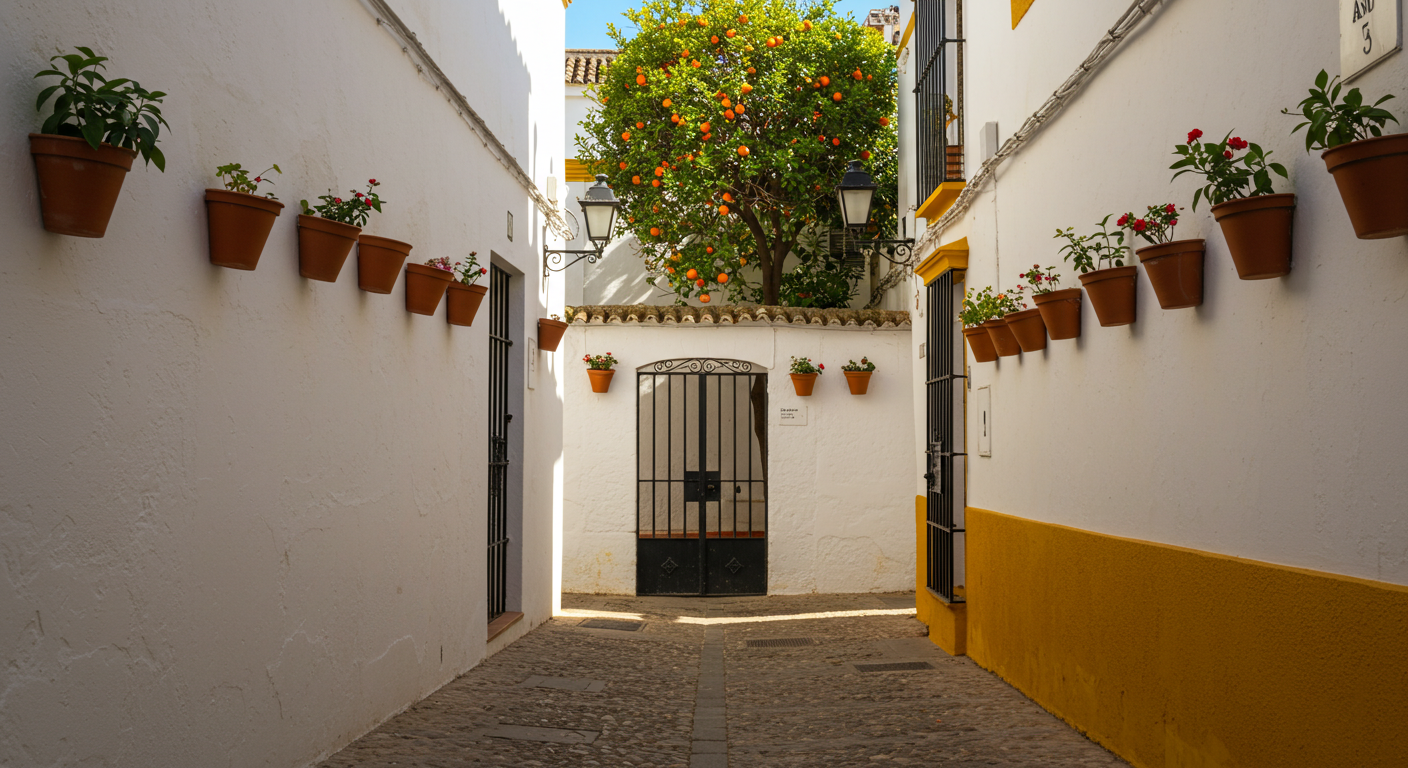
Santa Cruz is the old Jewish quarter, all whitewashed walls, orange trees, and impossibly narrow lanes. It's where most first-time visitors want to be, and there are good reasons for that. The Cathedral and the Giralda tower are a five-minute walk. The Alcázar entrance — worth queuing for, book ahead — is practically on the doorstep. The Archivo de Indias sits between the two. If you have three days and want to absorb the monumental city without ever needing transport, this is your neighbourhood.
The trade-off is real, though. By 10am in summer, some of the core lanes around Calle Mateos Gago and Plaza de Doña Elvira are thick with tour groups. Restaurant prices near the Cathedral run 20–30% higher than in adjacent areas. Noise on summer nights is considerable — Santa Cruz has a lot of bars, and the streets amplify sound. Book a place with air conditioning and double glazing; both are non-negotiable in July and August when temperatures regularly hit 40°C.
Accommodation here skews towards boutique hotels and small guesthouses, many of them in renovated palaces with internal courtyards. Prices for a decent double in summer 2026 range from around €120 to €250 per night depending on quality and how far you book in advance. The truly cheap options have mostly been displaced by tourist apartments.
For food within the neighbourhood, skip anything on the main tourist drag and head instead to Calle Santa María la Blanca or duck into the side streets around Plaza de los Venerables. Bodega Santa Cruz on Calle Rodrigo Caro is a genuine institution — loud, cheap, paper tablecloths, excellent montaditos.
El Centro: The Working City, Properly Priced
El Centro — the area around Calle Sierpes, Plaza del Salvador, and the Ayuntamiento — is where Sevillanos actually live and shop. It's the commercial heart of the city: department stores, independent shops, the covered Mercado de la Encarnación with the Metropol Parasol structure on top, and a density of tapas bars that cater to locals rather than tourists.
Plaza del Salvador is the single best square in Seville for early evening drinks. The terrace of Bar Eslava on Calle Eslava (just off to the west) does some of the most creative tapas in the city and fills up fast. El Rinconcillo on Calle Gerona — reportedly the oldest bar in Seville, though the claim should be taken with a pinch of salt — is worth one visit for the atmosphere alone.
For a short stay without a car, El Centro works extremely well. The Cathedral is a ten-minute walk south. Triana is fifteen minutes west across the Puente de Isabel II. The main bus station at Plaza de Armas is walkable. Hotels and apartments here tend to be slightly less expensive than Santa Cruz for comparable quality, and you're far more likely to be in a building that was designed as a hotel rather than shoehorned into a medieval townhouse.
The one mild downside: El Centro is noisier during the day from traffic and commerce, and some of the streets feel more anonymous. It lacks the immediate aesthetic charge of Santa Cruz. But if you're spending most of your time out exploring, that barely matters.
Arenal: Between the Cathedral and the River
Arenal occupies the triangle between the Cathedral, the river, and the bullring (the Real Maestranza, one of the oldest and most beautiful in Spain). It's a compact, manageable area that often gets overlooked in favour of its more famous neighbours.
The riverfront promenade along the Guadalquivir is lovely in the evenings — cooler than the interior streets, with views across to Triana. The Torre del Oro is a short walk. The Maestranza theatre, one of Spain's great opera houses, is here. And because it's not the first neighbourhood most guidebooks shout about, the tourist density is a notch lower than Santa Cruz.
Food in Arenal is a mixed picture. There are some excellent places — El Espigón on Calle Arfe does good fish, and the market on Calle Pastor y Landero is worth a morning visit — but there's also a fair amount of mediocre tourist-facing restaurants near the bullring. The rule applies everywhere in Seville: if the menu has photographs and is written in four languages, keep walking.
For accommodation, Arenal sits between the price points of Santa Cruz and El Centro. It's a solid choice if you want the Cathedral walkable but prefer a slightly quieter evening scene.
Triana: The Most Seville Neighbourhood of All
Triana is across the river, which psychologically puts off a surprising number of visitors. Don't be one of them. The Puente de Isabel II takes about four minutes to cross on foot. Triana is where flamenco took root, where the ceramics workshops have been since the Moorish period, and where Sevillanos go when they want to escape tourists while still eating and drinking well.
Calle Betis along the riverbank has the best views back towards the city skyline — a row of bars and restaurants with terraces facing the Guadalquivir and the Torre del Oro. It's touristy in parts, admittedly, but it's a different kind of tourist: people who've done their homework, rather than day-trippers following a flag.
The covered Mercado de Triana on Plaza del Altozano is excellent for breakfast and late-morning tapas. The ceramics shops along Calle Alfarería sell everything from tourist tat to genuinely beautiful hand-painted tiles — you can tell the difference by looking at whether the work is actually done on the premises. Casa Cuesta on Calle Castilla is the kind of old bar that looks like it hasn't changed since 1965, which is precisely why you should go.
Staying in Triana makes sense if you value neighbourhood character over proximity to monuments. You're not far from anything — the Cathedral is a twenty-minute walk or a short bus ride — but you feel genuinely embedded in the city rather than camped in its tourist core. Prices are slightly lower than Santa Cruz for equivalent quality, and the supply of genuinely local bars and shops is higher.
If this kind of immersive, on-foot approach to a city appeals to you, the slow travel guide to Granada covers similar ground for Seville's Andalusian neighbour.
Getting Around Without a Car: What You Actually Need to Know
The honest answer is that within the areas described above, you'll rarely need anything other than your feet. The distances are short and Seville's streets — while occasionally oven-hot in summer — are flat. Seville is also one of Spain's best cycling cities, with an extensive network of dedicated bike lanes (the carril bici) and a public bike-share scheme called Sevici. A Sevici subscription costs €15 for a week as of 2026 (check the current rate on their website before you go); it's brilliant for crossing between neighbourhoods quickly without breaking a sweat.
For longer trips — to the bus station, the train station at Santa Justa, or the airport — Uber and Cabify both operate in Seville and are generally cheaper and more reliable than flagging down a taxi on the street. The airport bus (the EA line) runs from the city centre to San Pablo Airport in about 35 minutes and costs around €4 each way.
The tram (metrocentro) runs a single line through the centre, useful for getting between Plaza Nueva and San Bernardo but not much else for most visitors. Don't bank on it solving your transport needs.
One thing nobody mentions: Seville's cobblestones are uneven and extensive. If you're travelling with heavy luggage, this is relevant. Wheels suffer. A bag you can carry on your back for the last few hundred metres to your accommodation will save you considerable frustration.
A Quick Comparison
To put it plainly:
- Santa Cruz — best for monument access and first-timers; highest prices and most tourist density
- El Centro — best for a mix of convenience, local life, and value; slightly less atmosphere
- Arenal — best for river access and a quieter evening pace; food quality is variable
- Triana — best for neighbourhood character and local bars; requires a short river crossing to reach the main sights
All four are entirely viable without a car. None requires a taxi for daily life.
When to Go and How Long to Stay
Three full days is the minimum to do Seville properly on foot. Four or five lets you slow down, take an afternoon in Triana, and not feel rushed at the Alcázar (book tickets online in advance — walk-up queues in summer are brutal).
Avoid July and August if you can. The heat is genuinely extreme — Seville regularly records the highest temperatures on mainland Spain — and the city is crowded. April is the sweet spot: Semana Santa and the Feria de Abril bring extraordinary atmosphere, though accommodation prices spike and you'll need to book months ahead. Late September and October are excellent: warm, less crowded, and the light is extraordinary.
If Seville is part of a wider Andalusian trip and you're curious about the coast, the best beaches guide for Spain in 2026 covers the options within easy reach of the city.
Seville rewards walkers. Stay central, pack light, leave the car at home — or better, don't hire one at all.
Frequently asked questions
- What is the best neighbourhood to stay in Seville without a car?
- Santa Cruz is the most convenient for first-timers — the Cathedral, Alcázar, and main tapas streets are all walkable. El Centro is a good alternative with slightly lower prices and a more local feel. Triana, across the river, offers the best neighbourhood character for travellers who don't mind a short walk to the main sights.
- Is Seville easy to get around without a car?
- Yes, very. The city centre is compact and flat, making it one of the most walkable cities in Spain. Seville also has an excellent public bike-share scheme (Sevici) and Uber and Cabify operate reliably for longer journeys like getting to the train station or airport.
- How far is Triana from the Cathedral in Seville?
- About 20 minutes on foot, crossing the Puente de Isabel II bridge. It sounds further than it feels — the walk along the river is pleasant and the bridge itself only takes around four minutes to cross.
- Is Santa Cruz in Seville too touristy?
- Parts of it are, especially the lanes immediately around the Cathedral. But it's a large neighbourhood and the streets around Plaza de los Venerables and Calle Santa María la Blanca feel considerably quieter. The key is choosing accommodation away from the main tourist drag and eating at bars that don't have photograph menus.
- What is the Sevici bike scheme in Seville and how does it work?
- Sevici is Seville's public bicycle hire scheme. You pick up and drop off bikes at docking stations across the city. A weekly subscription costs around €15 as of 2026, and journeys under 30 minutes are included in that fee. It's ideal for getting between neighbourhoods quickly, particularly in the cooler morning and evening hours.
- When is the best time to visit Seville?
- April and late September to October are the best months. April brings Semana Santa and the Feria de Abril — extraordinary atmosphere, but book accommodation months in advance and expect higher prices. July and August are brutally hot (regularly above 40°C) and very crowded; they're best avoided unless you have no choice.
- How do I get from Seville city centre to the airport without a car?
- The EA airport bus runs from the city centre (stopping near Puerta de Jerez and the main hotel zone) to San Pablo Airport in around 35 minutes and costs approximately €4 each way as of 2026. Uber and Cabify are also reliable and typically cost €20–€30 for the same journey depending on time of day.