Slow Travel in Santiago de Compostela: Cathedral, Old Town & Galician Food
Wondering how many days to spend in Santiago de Compostela? Two is the minimum; three is the sweet spot. Here's a slow, honest guide to the cathedral, barrio, and food.
How Many Days Do You Actually Need in Santiago de Compostela?
Two days is the minimum if you want to do more than photograph the cathedral and leave. Three days is the sweet spot — enough to eat properly, walk the old town without rushing, and sit in a square with a glass of Albariño at the hour when the pilgrims have gone to bed and the city belongs to itself again. Four days starts to feel indulgent unless you plan to use Santiago as a base for the Galician coast. Most people give it one night. Those people are wrong.
Santiago de Compostela is not a city you sprint through. It rewards slowness. The old town is compact — you can walk it end to end in twenty minutes — but that compactness is deceptive. There are covered arcades called soportales that run for blocks, keeping you dry in the near-constant drizzle. There are granite alleyways that open without warning onto squares you didn't know existed. There are restaurants that don't open until nine and don't expect you to leave until midnight. Give it time.
The Cathedral: What Nobody Tells You Before You Visit
The Catedral de Santiago de Compostela is one of the great pieces of Romanesque architecture in Europe. You already know that. What the guidebooks understate is how disorienting the interior is on a busy afternoon in July or August — packed with tour groups, pilgrims completing the Camino in floods of tears, and a general atmosphere of emotional overload. It's extraordinary and slightly overwhelming in equal measure.
The practical stuff worth knowing: the cathedral is free to enter, but the rooftop tour (Cubiertas) costs around €10 as of 2026 and is genuinely worth it — you walk across the stone roof above the Praza das Praterías and look down over the whole old city. Book it online the day before; it sells out in high season. The museum attached to the cathedral costs around €6 and contains the original Pórtico da Gloria figures, now moved inside to protect them from the elements — that alone is worth the entry price.
The botafumeiro — the enormous silver incense burner that swings on a rope across the transept during certain Masses — doesn't run at every service. It requires a donation from a pilgrim group to operate. Check the cathedral website for the schedule, or ask at your hotel. Seeing it is theatrical and faintly absurd and completely unmissable if you can time it right.
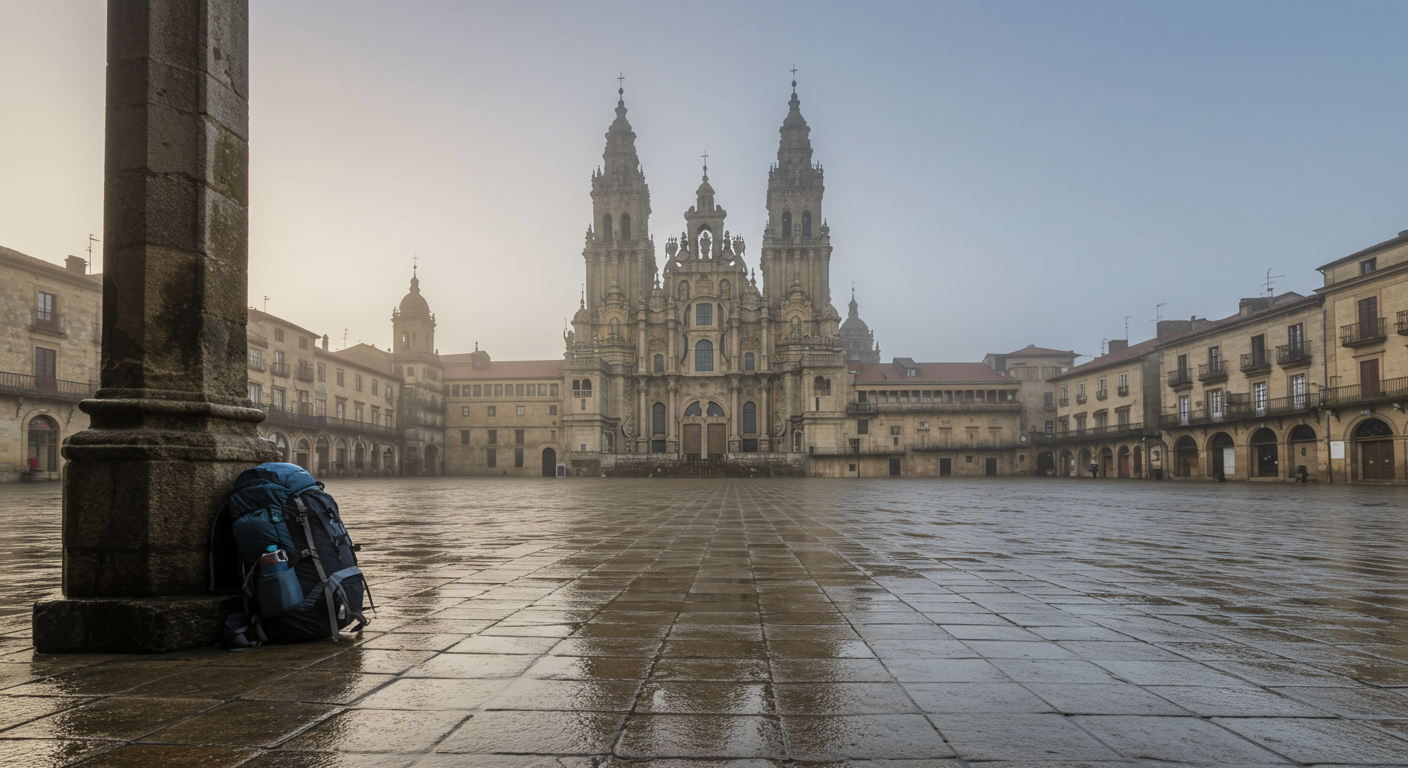
Get to the cathedral before 9am or after 7pm if you want the Praza do Obradoiro to yourself. In between, it's camera chaos.
Walking the Old Town: A Loose Order That Works
Start at the Praza do Obradoiro — the main façade — then walk clockwise. The Praza das Praterías on the south side is quieter and arguably more beautiful, with its fountain and the older, less-restored stonework. The Praza da Quintana to the east has a strange, austere geometry that feels less tourist-facing and more genuinely medieval. Early morning, with the mist still on the granite, it can stop you cold.
Rúa do Franco and Rúa da Raíña are the main eating streets, which means they're also the main tourist-trap streets. Most of the restaurants with laminated photos of food outside are firmly in the latter category. Walk one street back — try Rúa de San Pedro de Mezonzo or the area around the Mercado de Abastos — and the prices drop and the quality rises.
The Mercado de Abastos deserves its reputation. It opens Tuesday to Sunday, roughly 8am to 2pm, and it's a proper working market, not a performance. The fish hall is the centrepiece: turbot the size of a coffee table, percebes (barnacles) that cost an alarming amount per kilo, spider crab, and the flat-bodied rodaballo that Galicia does better than anywhere. You can buy directly from the stalls and take your purchases to one of the small restaurants inside the market, which will cook your fish for a small fee — usually €3–5 per person as of 2026. This is one of the best-value meals you will eat in Spain.
Galician Food: What to Eat and What to Skip
Galician cuisine is the antidote to the idea that Spanish food is all about olive oil and sunshine. This is Atlantic cooking — cold, wet, oceanic. The flavours are deep rather than bright.
Start with pulpo á feira (octopus with paprika and olive oil on wooden boards) if you haven't eaten it before. But honestly, after your second or third plate it gets repetitive — the version in tourist restaurants is often pre-frozen and microwaved. Seek out the stalls in the Mercado de Abastos or a pulpería that does it properly boiled to order.
Caldo gallego is the soup you want on a cold or rainy day — white beans, greens, potato, and pork, slow-cooked until it's almost a stew. It costs almost nothing and appears on nearly every menú del día. Don't skip it.
The empanada gallega is worth seeking out in a good bakery rather than a restaurant. It's a flat pastry pie filled with tuna and peppers, or pork, or sometimes cockles. The version from a good panadería — warm, flaky, eaten standing at the counter — is one of those small pleasures that make you understand why people move to a place.
For cheese: queso de tetilla is the local soft cow's-milk cheese, shaped like a breast (the name is literal). It's mild and creamy. Arzúa-Ulloa is slightly more complex. Both are sold at the market and in any decent supermarket.
For wine: the region's Albariño is the default choice and it's a good one — crisp, slightly saline, works with anything from the sea. If you want something different, ask for a ribeiro, which is lighter and slightly more mineral. Avoid any restaurant that charges more than €3.50 for a glass of house wine; you're in Galicia, not Madrid.
A Note on the Menú del Día
Santiago's menú del día — the fixed three-course lunch — runs €12–16 in most decent places as of 2026, which includes bread, a glass of wine or water, and dessert. This is not a tourist concession; it's how most local workers eat at midday. Lunch is between 2pm and 4pm. Arriving at 1pm will get you strange looks; arriving at 3:30pm will get you the last table. Aim for 2:15pm.
Where to Stay: The Honest Breakdown
The old town (Zona Monumental) is the obvious choice. It's walkable, atmospheric, and genuinely convenient. The trade-off is noise — particularly around the Rúa do Franco area on weekends, which gets loud until at least 2am. Request a room facing an interior courtyard if you're a light sleeper.
The Parador de Santiago — officially the Hostal dos Reis Católicos — is one of the great historic paradores in Spain, a 15th-century pilgrim hospital that now operates as a five-star hotel. A room costs €200–350 per night depending on season as of 2026. It's spectacular and the location on the Praza do Obradoiro is unbeatable. Worth it once, if it fits your budget.
For something more modest, the streets around Rúa de San Francisco and toward the Alameda park have small guesthouses (pensiones) at €60–90 for a double. Perfectly adequate; quieter than the cathedral end.
Getting There and Getting Around
Santiago has its own airport (SCQ) — Rosalía de Castro Airport — with connections from Madrid, Barcelona, and several UK airports. The AVE high-speed train connects from Madrid in roughly 5.5 hours; from Vigo in 30 minutes. From A Coruña it's about 35 minutes by train. The bus network (ALSA) connects Santiago to most of Galicia cheaply and reliably.
Once you're in the old town, you walk. That's it. The historic centre is pedestrianised, and the distances are small. Taxis exist for the airport run (around €20–25 as of 2026) but you won't need one during your stay.
If You're Considering a Longer Stay
Santiago is increasingly attractive to remote workers and slow-travel types. It's a university city, which means it has a year-round population that isn't entirely dependent on tourism. Rents are considerably lower than Madrid or Barcelona — a decent one-bedroom in the old town or the adjacent Ensanche neighbourhood runs €600–900 per month as of 2026, though supply is tight. If you're thinking about making Spain a longer-term base, the administrative side of things has its own learning curve: sorting a Spanish bank account as a non-resident, understanding how renting works without a Spanish payslip, and eventually the empadronamiento process all take time and patience. Santiago's pace makes that paperwork feel slightly less maddening.
For anyone considering the Spanish Digital Nomad Visa as a route in, it's worth reading the fine print carefully — the income requirements are non-trivial and the processing timelines are longer than the government websites imply.
One Last Thing
The best hour in Santiago is around 10pm on a Tuesday in late September, when the summer crowds have gone, the pilgrim season is winding down, and the granite is still holding the warmth of the afternoon. Find a bar on the Praza de Cervantes — not one of the obvious ones — order a cunca of wine and a plate of empanada, and watch the city do nothing in particular. That's the version of Santiago most people never get to.
Frequently asked questions
- How many days do you need in Santiago de Compostela?
- Three days is the ideal amount of time. Two days is the workable minimum if you focus on the cathedral, one solid walk through the old town, and at least one proper meal at the Mercado de Abastos. With three days you can eat well, visit the rooftop tour, explore the quieter squares, and take the pace down to something that actually suits the city.
- Is Santiago de Compostela worth visiting if you haven't done the Camino?
- Absolutely. The city has its own identity beyond the pilgrimage — a working university, a serious food culture, and one of the best-preserved Romanesque old towns in Europe. You don't need to have walked anywhere to appreciate it. The Camino crowd adds atmosphere rather than dominates it, especially outside July and August.
- What is the best time of year to visit Santiago de Compostela?
- May, June, and September are the sweet spots. July and August are busy and expensive, though the city handles crowds better than somewhere like Dubrovnik. October is increasingly popular and has a moody, atmospheric quality that suits the granite architecture perfectly. Winter is quiet and very wet, but the city functions normally and prices drop significantly.
- What Galician food should I try in Santiago de Compostela?
- Prioritise pulpo á feira (octopus with paprika), caldo gallego (the hearty bean and greens soup), fresh fish from the Mercado de Abastos cooked on the spot, and empanada gallega from a proper bakery. For cheese, try queso de tetilla or Arzúa-Ulloa. Drink Albariño or ask for a ribeiro if you want something lighter.
- Is the cathedral botafumeiro ceremony free to watch?
- Yes, watching the botafumeiro swing during Mass is free — but it only happens at certain services, typically when a pilgrim group has made the required donation. Check the cathedral's official website for the current schedule before your visit, as it changes seasonally and isn't guaranteed at every Mass.
- How do you get from Santiago de Compostela airport to the city centre?
- There's a bus (line C) that runs between the airport and the city centre for around €3 as of 2026, taking roughly 30–40 minutes depending on traffic. A taxi to the old town costs approximately €20–25. There's no direct train link to the airport from the city centre.
- Can you use Santiago de Compostela as a base for the Galician coast?
- Yes, easily. The Rías Baixas coast — including Cambados, Sanxenxo, and the O Grove peninsula — is around 45–60 minutes by car or bus. A Coruña is 35 minutes by train. If you're renting a car for a few days, you can combine the city with the coast very comfortably. Public transport covers the main towns but a car gives you access to the smaller coves.