Beaches of the Basque Country: San Sebastián, Surf and the Green Northern Coast in Summer
From La Concha's perfect arc to wild surf breaks at Mundaka, discover the Basque Country's best beaches, hidden coves and coastal towns for summer 2026.
There is a particular kind of satisfaction in arriving at a Basque beach and finding it genuinely beautiful without being remotely overcrowded. The northern coast of Spain — green, dramatic, and frequently misunderstood — rewards travellers who are willing to swap guaranteed sunshine for something altogether more interesting: a coastline that actually looks like a coastline, with cliffs, surf, fishing villages and one of the world's great food cities sitting at its western edge.
This guide covers the beaches of the Basque Country (Euskadi) in practical, honest detail — what each one is actually like, when to go, how to get around, and what to eat and drink while you're there. Whether you're planning a week-long trip or considering a longer stay, the northern coast in summer is one of Spain's most underrated experiences.
What to Expect from Basque Beaches
First, a reality check. The Basque coast is not the Mediterranean. Water temperatures in summer (July–August) sit at around 18–21°C — refreshing rather than bath-warm. The weather is Atlantic: mostly sunny in July and August, but with a real chance of rain at any time, and afternoon clouds that roll in from the sea. Locals call it sirimiri — the fine drizzle that can appear from nowhere and vanish just as quickly.
What you get in return is extraordinary: lush green hills dropping straight into the sea, beaches that are clean and well-managed, surf that is genuinely world-class, and a coastal culture built around food, fishing and a fierce sense of place. If you've spent time on the Costa del Sol or the Balearic Islands, the Basque coast will feel like a different country — which, in many ways, it is.
As of 2026, the Basque Country remains one of Spain's wealthiest and best-maintained regions. Beach infrastructure is excellent: clean water, Blue Flag status at most major beaches, good public transport links and a strong local hospitality industry.
San Sebastián (Donostia): The City and Its Beaches
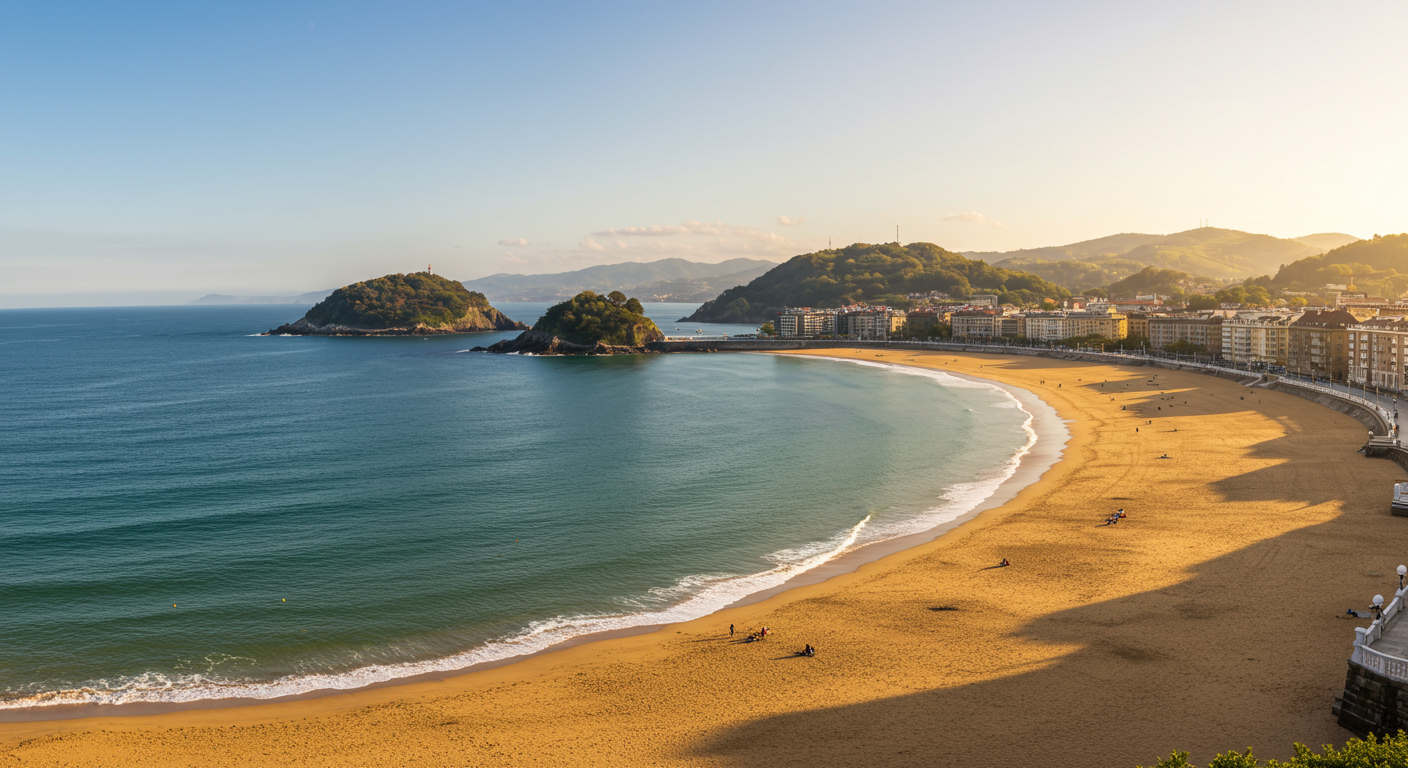
San Sebastián is the obvious starting point, and rightly so. The city of roughly 186,000 people sits around a perfect horseshoe bay, with two main urban beaches that would be the headline attraction of almost any other city in Europe.
La Concha
La Concha is, quite simply, one of the most beautiful urban beaches in the world. The name means 'the shell', and the bay earns it — a near-perfect arc of fine golden sand, sheltered by the small island of Santa Clara, with the elegant promenade (paseo) running its full length. In summer, the beach fills up, but it never feels chaotic in the way that Barcelona's Barceloneta does. The water is calm enough for children, the sand is well-maintained, and the backdrop — Belle Époque hotels, green hills, the old town to one side — is genuinely spectacular.
Practical notes: sunbeds and parasols are available for hire (around €12–15 for a set, as of 2026). The beach gets busy from late morning; arrive before 10am or after 6pm for more space. The promenade walk from La Concha around to Ondarreta takes about 25 minutes and is one of the great urban strolls in Spain.
Ondarreta
Separated from La Concha by a rocky outcrop, Ondarreta is slightly smaller, slightly less famous, and slightly more local in character. Families from the Gros and Antiguo neighbourhoods tend to come here. The swimming is equally good, and the Peine del Viento — Eduardo Chillida's iconic iron sculptures embedded in the rocks at the beach's western end — are worth the walk alone.
Zurriola (Gros Beach)
On the other side of the Urumea river, Zurriola is the surf beach. Facing the open Atlantic with a consistent swell, it's where the city's younger crowd goes, where surf schools operate from April through October, and where the Quiksilver Pro surf competition has historically been staged. Lessons for beginners cost around €40–55 for a two-hour group session with equipment included (as of 2026). The Gros neighbourhood behind the beach is also worth exploring: less touristy than the old town, with excellent pintxos bars on Calle Zabaleta and Calle San Francisco.
For a full guide to eating your way through the city, see our guide to pintxos, fine dining and everything in between in San Sebastián.
Beyond San Sebastián: The Coast Heading West
The real discovery begins when you leave the city and follow the coast westward into Gipuzkoa and Bizkaia provinces. The GI-638 and BI-2238 coastal roads are among the most scenic drives in Spain.
Zarautz
Thirty minutes west of San Sebastián by car or bus (the Lurraldebus network connects them regularly), Zarautz has the longest beach in the Basque Country — about 2.5km of wide, open sand backed by a pleasant town. It's a serious surf destination: the Zarautz surf break hosts professional competitions, and the town has a strong surf culture with multiple schools and board rental shops. Out of the water, the old quarter has good pintxos bars and a relaxed, unpretentious atmosphere. Accommodation is significantly cheaper than San Sebastián — a good double room in a hostal runs around €80–110 per night in high summer, as of 2026.
Getaria
A few kilometres further west, Getaria is a small fishing village built on a narrow promontory with a tiny beach on each side. It's the birthplace of Juan Sebastián Elcano (the first person to circumnavigate the globe) and of Cristóbal Balenciaga (the fashion designer). The Balenciaga Museum on the hill above the village is genuinely excellent. The real reason to come, though, is the food: Getaria is famous for its txakoli (the local dry, slightly sparkling white wine) and for its grilled fish restaurants. The besugo (sea bream) and rodaballo (turbot) cooked over charcoal at places like Kaia-Kaipe are among the best things you'll eat on the entire coast.
Zumaia and the Flysch Coast
Zumaia sits at the mouth of the Urola river and has two beaches: Itzurun, famous for its extraordinary flysch rock formations (horizontal layers of sedimentary rock tilted 90 degrees, creating a dramatic cliff face that served as a filming location for Game of Thrones), and Santiago, a more conventional sandy beach on the other side of the headland. The flysch cliffs between Zumaia and Deba can be walked at low tide — one of the most unusual coastal walks in Spain, through 60 million years of geological history. Check tide times carefully before you go.
Bizkaia: Mundaka, Lekeitio and the Eastern Coast
Crossing into Bizkaia province, the coast becomes wilder and the villages more remote.
Mundaka
Mundaka is a name that means something specific to surfers: it has one of the longest and most perfect left-hand barrel waves in Europe, formed by a sandbar at the mouth of the Urdaibai estuary. In the right conditions (typically autumn and winter, but also possible in summer), the wave can run for several hundred metres. In summer, the wave is smaller and more accessible for intermediate surfers. The village itself is charming — a cluster of stone houses around a small harbour, with the church of Santa María at the top and views across the estuary to the Urdaibai Biosphere Reserve. There are a handful of good restaurants and a couple of surf schools. It's not a resort; it's a real place that happens to have a famous wave.
Lekeitio
East of Mundaka, Lekeitio is arguably the most beautiful fishing town on the Basque coast. The beach — Isuntza — is wide and sandy, split in two by a small island (Garraitz) that you can walk to at low tide. The old town behind it has a Gothic church, a working fishing harbour, and a main square lined with bars serving excellent pintxos. On the first Sunday of September, the town holds its famous Antzar Eguna (Goose Day) festival, which is exactly as chaotic and entertaining as it sounds. In summer, Lekeitio gets busy with Basque families on holiday — it's popular domestically, less so with international tourists, which keeps it feeling authentic.
Laida and Laga
Inside the Urdaibai Biosphere Reserve, the beaches of Laida and Laga face each other across the estuary mouth. Laga, in particular, is a wild, open beach with dunes, strong surf and a backdrop of green hills. There are no hotels immediately adjacent — you park (spaces fill up by 10am in July and August) and walk. This is the Basque coast at its most elemental.
Practical Planning: Getting Around
The Basque Country's public transport is genuinely good by Spanish standards. From San Sebastián, Lurraldebus buses reach Zarautz, Getaria and Zumaia easily. The Euskotren railway line connects San Sebastián to Bilbao along the coast, stopping at Zarautz, Zumaia and other towns — slow but scenic. For Mundaka and Lekeitio, a car is essentially necessary unless you're happy with infrequent rural bus services.
Bilbao's airport (BIO) has good connections from the UK and across Europe. San Sebastián's airport (EAS) is small and has limited international routes; most visitors fly into Bilbao or use the high-speed AVE train from Madrid to San Sebastián (around 5 hours 20 minutes, with tickets from around €30 booked in advance, as of 2026).
When to Go
July and August are the most reliable months for beach weather, though even then you should pack a light layer for evenings. June is increasingly popular — the coast is quieter, accommodation is cheaper and the landscape is at its most vividly green. September is excellent: the summer crowds thin out, water temperatures are at their warmest (having absorbed months of sun), and the surf picks up. The Semana Grande festival in San Sebastián falls in mid-August and is worth experiencing — but book accommodation months in advance.
For comparison with other Spanish coastal options, our coast-by-coast guide to the best beaches in Spain for summer 2026 puts the Basque coast in useful context alongside the Costa Brava and the Mediterranean south.
Where to Stay
San Sebastián has accommodation across all price points, but it's expensive by Spanish standards. Expect to pay €150–250 per night for a decent mid-range hotel in the old town or Gros neighbourhood in July or August, as of 2026. The Parte Vieja (old town) is atmospheric but noisy at night; Gros is younger and slightly calmer. For longer stays or a slower pace, renting an apartment in Zarautz, Getaria or Lekeitio gives you a more genuinely local experience at considerably lower cost.
If you're considering a longer stay in the region — perhaps working remotely while exploring the coast — the Basque Country's combination of high quality of life, strong infrastructure and relatively manageable cost of living (outside San Sebastián's centre) makes it worth investigating. Our guide to the non-lucrative visa versus the digital nomad visa is a useful starting point for understanding your options.
Eating on the Coast
The Basque Country has the highest density of Michelin-starred restaurants per capita of anywhere in the world, but the coast's greatest pleasure is simpler than that: a cold glass of txakoli, a plate of grilled anchovies from Getaria, and a table overlooking the harbour. The pintxo culture of San Sebastián extends along the coast — every village has a bar doing something worth eating. Look for kokotxas (cod cheeks), txipirones (small squid), and whatever the day's catch happens to be.
The Basque coast in summer is one of those rare places that manages to be both genuinely beautiful and genuinely itself — not a resort, not a performance, but a living coastline with its own language, food, culture and stubborn pride. It takes a little more effort to get to than the Mediterranean, and it asks slightly more of the weather gods. In return, it gives you something that's increasingly hard to find on the Spanish coast: the feeling that you've actually arrived somewhere.
Frequently asked questions
- Is the water warm enough to swim at Basque Country beaches in summer?
- Yes, though it's cooler than the Mediterranean. Water temperatures along the Basque coast typically reach 18–21°C in July and August — perfectly swimmable, but refreshing rather than warm. Wetsuits are standard for surfers year-round and for swimmers who feel the cold.
- How do I get from San Sebastián to the other Basque coastal towns without a car?
- Lurraldebus buses connect San Sebastián to Zarautz, Getaria and Zumaia regularly throughout the day. The scenic Euskotren railway also links San Sebastián to Bilbao with coastal stops. For Mundaka and Lekeitio, a hire car is strongly recommended as public transport connections are infrequent.
- When is the best time to visit the Basque coast for beaches?
- July and August offer the most reliable beach weather, though rain is always possible. June is quieter and greener, with lower prices. September is arguably the best month overall: warm water, thinner crowds, better surf and excellent local festivals. Avoid August in San Sebastián unless you book accommodation many months ahead.
- Is La Concha beach in San Sebastián safe for children?
- Yes — La Concha is one of the safest urban beaches in Spain for families. The bay is sheltered by the island of Santa Clara, which breaks the Atlantic swell and keeps the water calm. Lifeguards are on duty throughout the summer season, and the beach has excellent facilities including showers, toilets and sunbed hire.
- Can beginners learn to surf on the Basque coast?
- Absolutely. Zurriola beach in San Sebastián and Zarautz are the best spots for beginners, with multiple surf schools offering group lessons for around €40–55 for two hours including equipment, as of 2026. Mundaka's famous wave is strictly for experienced surfers.
- How expensive is San Sebastián compared to other Spanish beach destinations?
- San Sebastián is one of the priciest cities in Spain. Expect to pay €150–250 per night for a mid-range hotel in high summer, and €4–6 per pintxo in bars. It's comparable to Barcelona and significantly more expensive than most Mediterranean resort towns. Staying in nearby Zarautz or Getaria and day-tripping in can cut costs considerably.
- What is the flysch coast near Zumaia, and is it worth visiting?
- The flysch coast between Zumaia and Deba is a UNESCO Geopark featuring extraordinary tilted rock strata — layers of sedimentary rock that record 60 million years of geological history, now standing nearly vertical. It's visually stunning and unlike anything else on the Spanish coast. You can walk the cliffs at low tide or take a boat tour from Zumaia harbour. It's absolutely worth a half-day.