NIE vs TIE Spain: What They Are and How to Get Them
NIE and TIE explained clearly: what each document is, who needs which, and a step-by-step guide to getting them in Spain in 2026.
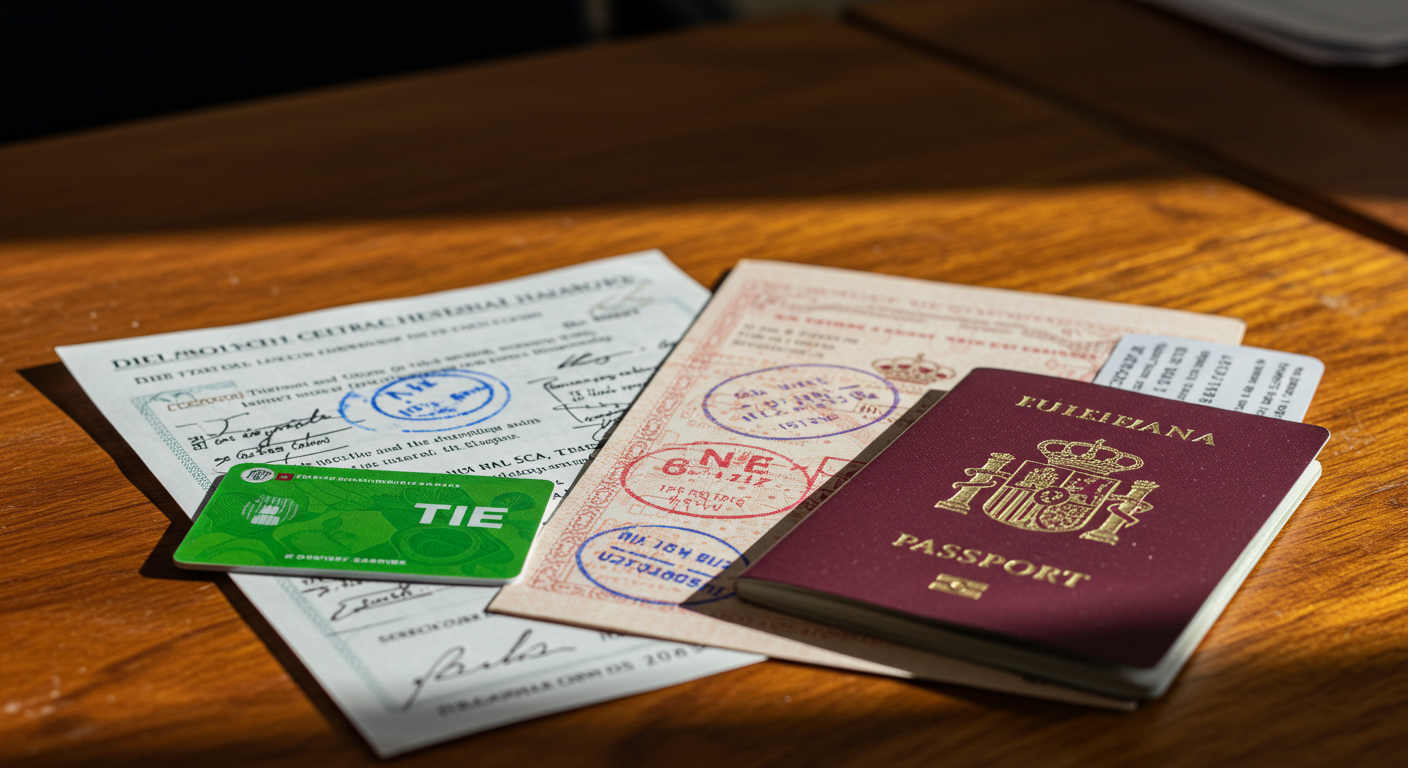
Spain has a talent for bureaucratic terminology that sounds interchangeable until it really, really isn't. NIE and TIE are two of the first acronyms you'll encounter when you start building a life here — and confusing them wastes time, money, and the considerable emotional energy required for a morning at the foreigners' office.
Here's the short answer: the NIE (Número de Identidad de Extranjero) is simply a tax identification number assigned to foreigners — a string of digits that follows you through every official transaction in Spain. The TIE (Tarjeta de Identidad de Extranjero) is a physical residency card that proves you have the legal right to live here. You need the NIE first; the TIE comes later, once you've secured residency. They're related but not the same thing, and plenty of people arrive thinking they're applying for one when they actually need the other.
What the NIE Actually Is
The NIE is a nine-character code — a letter, seven digits, and another letter — that functions as your Spanish tax number. Think of it as the equivalent of a National Insurance number in the UK, or a Social Security number in the US, but for foreigners. It doesn't expire, it doesn't grant you the right to stay, and it tells you almost nothing about your immigration status. What it does do is make you visible to the Spanish tax system.
You need one for practically everything: buying a car, signing a lease, opening a bank account (see Open a Spanish Bank Account as a Non-Resident in 2026), paying taxes, registering as autónomo, or buying property. Even non-residents who buy a holiday flat in Marbella need an NIE — they'll apply at a Spanish consulate abroad and never live here a single day.
The NIE itself is issued on a small white certificate (the EX-15 form, stamped and signed). It is not an ID card. It won't get you through any border. It's purely a number on a piece of paper.
What the TIE Actually Is
The TIE is a biometric plastic card — green, credit-card sized — that serves as your official ID document in Spain once you're a resident. It shows your photo, your NIE number, your nationality, your residency category, and an expiry date. It's issued by the Policía Nacional.
Not every resident gets a TIE. EU citizens who register as residents receive a different document: a certificado de registro de ciudadano de la UE, which is a simple green A4 certificate rather than a card. The TIE is specifically for non-EU nationals — Brits (post-Brexit), Americans, Australians, Canadians, and so on — who hold a long-stay visa or residency permit.
If you're a British citizen who moved to Spain before 31 December 2020 and registered under the Withdrawal Agreement, your TIE will say Residente — Acuerdo de Retirada on it. If you arrived after that date on a visa (Non-Lucrative, Digital Nomad, etc.), your TIE will reflect that visa category instead.
The TIE has an expiry date tied to your residency authorisation. When your residency is renewed, you apply for a new TIE.
Who Needs What, and When
This is where people get tangled. A rough guide:
- Non-resident foreigner (buying property, signing a one-off contract, paying taxes): NIE only, obtained at a consulate abroad or at a foreigners' office in Spain.
- EU/EEA citizen moving to Spain long-term: NIE plus the certificado de registro — not a TIE.
- Non-EU citizen with a long-stay visa (NLV, Digital Nomad, student, etc.): NIE first, then TIE within 30 days of arrival in Spain.
- Non-EU citizen under the Withdrawal Agreement: TIE with the specific WA notation.
If you're arriving on the Spanish Digital Nomad Visa, the sequence is: get your visa approved at the consulate → enter Spain → apply for your TIE within a month. Your NIE will be embedded in the TIE.
Step-by-Step: Getting Your NIE
This is the route for a non-EU national already in Spain who needs a standalone NIE — most commonly someone buying property or signing contracts while on a tourist stay.
Step 1: Get a cita previa
Book an appointment online at the Sede Electrónica del Ministerio del Interior (sede.mjusticia.gob.es is for justice; for extranjería you want the Policía Nacional's appointment system at citacnp.ses.mir.es). Select Policía — Expedición de Certificados y Tarjetas, then Asignación de NIE.
Appointments can be brutal to find in cities like Madrid, Barcelona, and Málaga. Read Cita Previa Extranjería: How to Get an Appointment When None Exist before you panic — there are legitimate strategies for finding slots.
Step 2: Prepare your documents
For a standard NIE application at a foreigners' office in Spain, you'll need:
- Completed EX-15 form (downloadable from the Interior Ministry site)
- Original passport plus a photocopy of the bio-data page
- Proof of the reason you need the NIE (a property purchase contract, employment offer, tax obligation, etc.) — Spain requires you to justify the need
- Tasa 790, Código 012: the official fee form, paid at a bank before your appointment. As of 2026, the fee is around €11–12; check the current rate on the AEAT website
- Two passport-size photos (some offices ask, some don't — bring them anyway)
Step 3: Attend the appointment
Arrive a few minutes early. The officers are not unkind, but they have no patience for missing documents. Hand everything over, they'll process it, and in most cases you'll receive the stamped NIE certificate the same day or within a few working days. In busier offices it can take longer — up to a couple of weeks.
Step 4: Keep it safe
That small white certificate is surprisingly easy to lose. Scan it, store it in the cloud, and keep a certified photocopy. Replacing it is possible but involves another appointment.
Step-by-Step: Getting Your TIE
This process assumes you've entered Spain on a long-stay visa issued by a Spanish consulate abroad.
Step 1: Register on the padrón
Before applying for your TIE, register your address at the local ayuntamiento (town hall). This gives you a volante de empadronamiento, which you'll need for the TIE application. If your rental situation is complicated, Empadronamiento Without a Rental Contract: Your Real Options covers the workarounds.
Step 2: Book your cita previa
Same system as the NIE: citacnp.ses.mir.es. This time select Policía — Toma de Huella (Tarjeta de Residencia). You have 30 days from entry to apply, so don't sit on this. In practice, getting an appointment within 30 days in cities like Barcelona or Madrid can be genuinely difficult — see NIE Appointment in Spain 2026: How Long the Wait Really Is for realistic timescales and how to speed things up.
Step 3: Prepare your documents
The exact list varies slightly by visa type, but for most non-EU residency categories you'll need:
- Completed EX-23 form
- Original passport plus full photocopy
- Your long-stay visa (still valid or recently expired — entering on it is what counts)
- Volante de empadronamiento
- Tasa 790, Código 012 — same fee form as the NIE, paid at a bank beforehand. As of 2026, around €16–18 for the TIE itself (check current rate)
- Three passport-size photos (biometric standard)
- Proof of residency authorisation (your visa approval letter or resolution)
For Digital Nomad Visa holders, you'll also bring proof of remote work and income. For Non-Lucrative Visa holders, proof of sufficient funds and private health insurance.
On the healthcare front, be aware that your EHIC or travel insurance typically won't count for TIE purposes — you'll need either Spanish public health access or a qualifying private policy.
Step 4: Attend the appointment — biometrics taken
Unlike the NIE, this appointment involves fingerprints and a photo. The process takes about ten minutes once you're in the chair. The officer checks your documents, takes your biometrics, and gives you a receipt (resguardo).
Step 5: Collect your TIE
The card is not issued on the day. It typically takes 4–8 weeks to be ready, though this varies by city and by how backed-up the Policía Nacional is. You'll usually collect it from the same office. Some offices send an SMS when it's ready; others just tell you to come back after 30–45 days. Keep your resguardo — it serves as proof of your application status in the meantime.
Common Mistakes Worth Knowing About
Paying the tasa at the wrong office is a classic one. The 790-012 form must be paid at a Spanish bank — you can't pay it at the foreigners' office itself. Sabadell and BBVA branches tend to be efficient about this; CaixaBank can be hit or miss depending on the branch.
Bringing photocopies but forgetting the originals is another. Bring both, always.
If you're planning to work as a freelancer here, you'll eventually need to register as autónomo — and your NIE/TIE is the foundation of that whole process. Do You Need a Gestor to Register as Autónomo in Spain? is worth reading before you get there.
Finally, don't assume that having a TIE means you can open a bank account without further paperwork. Banks have their own compliance requirements. Open a Spanish Bank Account as a Non-Resident in 2026 covers what they actually ask for.
A Note on Timelines in 2026
The honest answer is that both processes take longer than they should, and both have gotten more congested in major cities over the past few years. For the NIE, budget 2–6 weeks from starting your appointment search to holding the certificate in cities like Madrid or Barcelona. For the TIE, the full process from appointment booking to card collection can stretch to 2–3 months in busy areas. Provincial cities — Cáceres, Logroño, Almería — are generally much faster.
If you're renting in the meantime and need to show proof of income or work status to a landlord, Renting in Spain Without a Spanish Payslip: How Foreigners Do It covers the documentation strategies that actually work.
Getting these documents sorted is unglamorous, slow, and occasionally maddening. But once you have them, a surprising amount of Spain opens up — financially, legally, practically. The bureaucracy is the price of admission.
Frequently asked questions
- Can I use my NIE as proof of residency in Spain?
- No. The NIE is just a tax identification number — a string of digits on a certificate. It does not prove you have the right to live in Spain. Proof of residency comes from your TIE (for non-EU nationals) or your certificado de registro (for EU citizens). Landlords and banks who ask for 'residency proof' want one of those, not the NIE certificate.
- Do EU citizens get a TIE?
- Generally no. EU, EEA, and Swiss citizens who register as residents in Spain receive a certificado de registro de ciudadano de la UE — a green A4 paper certificate, not a plastic card. The TIE (biometric card) is issued to non-EU nationals. The exception is some EU citizens who applied under certain transitional arrangements, but this is rare.
- How long does it take to get an NIE appointment in Spain in 2026?
- It depends heavily on the city. In Madrid, Barcelona, Valencia, and Málaga, waits of 3–6 weeks are common; in smaller provincial cities it can be a matter of days. Slots appear and disappear quickly on the official booking system, so checking at off-peak hours (early morning, late evening) improves your chances. See our detailed guide on NIE appointment wait times for city-by-city detail.
- What happens if I don't apply for my TIE within 30 days of arriving in Spain?
- Technically, the law requires you to apply within 30 days of entry. In practice, if you can demonstrate you tried to book an appointment and couldn't get one in time — which is genuinely common in 2026 — the authorities are generally understanding. Keep screenshots of failed booking attempts as evidence. That said, don't leave it indefinitely: being out of status creates complications for renewals and banking.
- Can I apply for a NIE from outside Spain?
- Yes. Non-residents who need a NIE for a Spanish property purchase or tax obligation can apply at a Spanish consulate in their home country. The process varies by consulate — some require an appointment, some accept postal applications — but the end result is the same stamped EX-15 certificate. This route is common for people buying holiday property in Spain who don't intend to live there.
- Do I need a NIE before I can apply for a TIE?
- Not exactly — the NIE number is assigned as part of the TIE process for most visa holders. When you apply for your TIE after arriving on a long-stay visa, the NIE is embedded in the card itself. You don't need to separately obtain a standalone NIE certificate first unless you need the number for a transaction (like a property purchase) before your TIE arrives.
- Is the Tasa 790 Código 012 the same for both the NIE and the TIE?
- It's the same form (Tasa 790, Código 012) but the amount differs slightly depending on what you're applying for. As of 2026, the NIE certificate fee is roughly €11–12 and the TIE card fee is around €16–18. Always check the current rates on the official AEAT or Interior Ministry website before your appointment, as these figures are updated periodically.