A Slow Weekend in Cuenca: Hanging Houses & Spain's Interior
A weekend trip to Cuenca from Madrid by train takes under an hour. Here's how to do it slowly, what to eat, where to stay, and why most visitors rush it.
Weekend Trip to Cuenca from Madrid by Train: What to Know Before You Go
The high-speed AVE from Madrid Atocha to Cuenca takes 55 minutes and costs somewhere between €12 and €30 depending on how far ahead you book (as of 2026). That's faster than getting across Madrid in rush hour. The problem is that most people use this speed against themselves — they arrive at 10am, photograph the hanging houses, eat a morteruelo, and are back on the 4pm train. That's not a trip to Cuenca. That's a tick-box.
Do it differently. Cuenca rewards the people who stay overnight, who walk the gorge at dusk when the tour groups have gone, who find the wine bar on Calle Alfonso VIII that has no sign and closes whenever the owner feels like it. This is a guide for those people.
Getting There: The Train Is the Only Sensible Option
Driving from Madrid is about two hours via the A-3, which is fine if you want to stop in the villages along the way — Tarancón, Saelices, the Roman ruins at Segóbriga if you're that way inclined. But honestly, the train is the move. Renfe runs multiple daily AVE services from Atocha; the earliest is usually around 7am, the last return from Cuenca Fernando Zóbel station is late enough that you can have dinner.
The station sits about 5km from the old city (the casco antiguo up on the gorge). Taxis wait outside and charge a fixed €8–10 to the historic centre. There's also a local bus, Line 1, but it runs infrequently and the timetable has a way of changing without announcement. If you're staying the night, most hotels will tell you the taxi is non-negotiable — they're not wrong.
One thing nobody mentions: the station area, Cuenca Nueva, is a perfectly ordinary Spanish new town. Fine for a supermarket run. Don't let it colour your first impression of the place.
The Hanging Houses: What They Are and How to See Them Properly
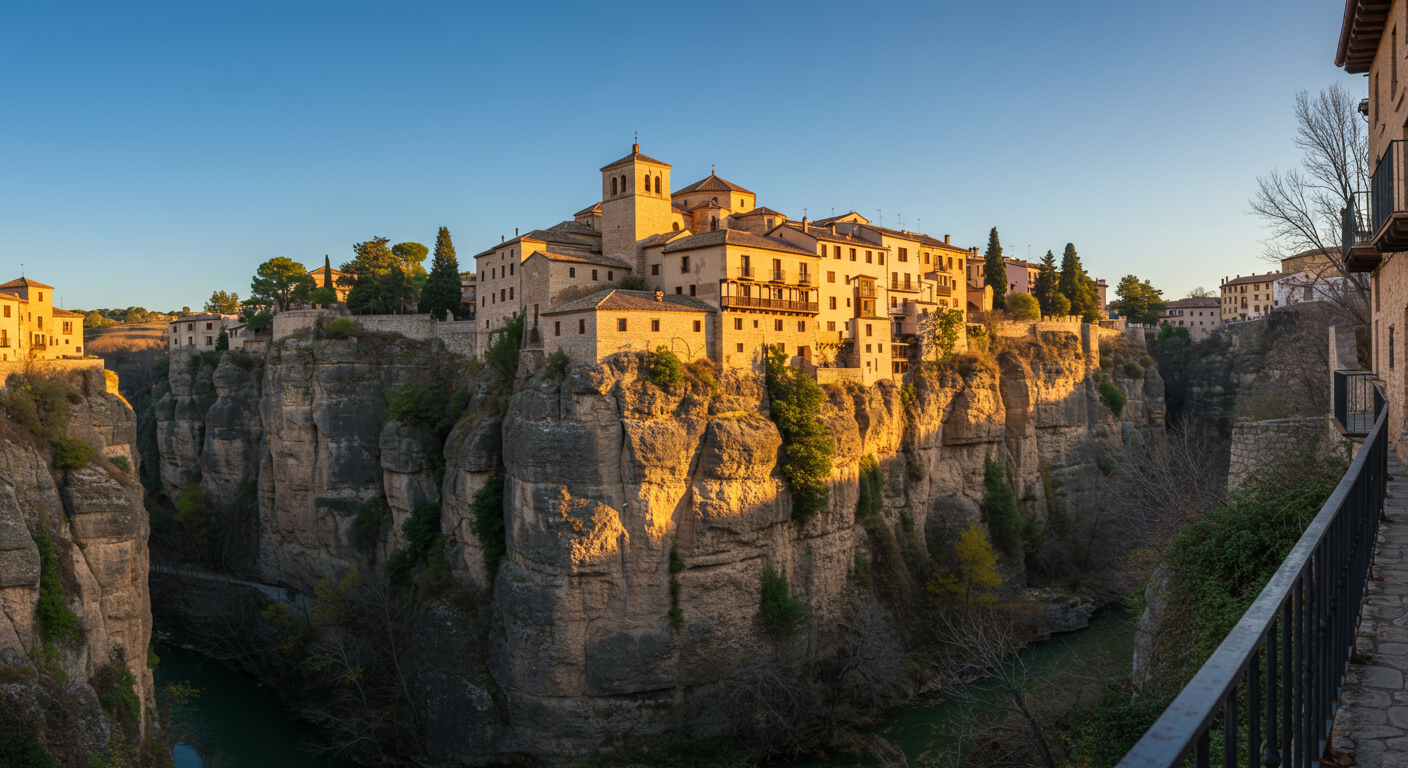
The Casas Colgadas — the hanging houses — are genuinely extraordinary. Three 14th-century buildings clamped to the edge of a limestone gorge, their wooden balconies jutting out over a 40-metre drop to the Huécar river. The most-photographed view is from the iron footbridge, the Puente de San Pablo, which crosses the gorge at eye level with the houses. Get there before 9am or after 7pm if you want it to yourself.
What the photos don't convey is the smell of the gorge in summer — pine resin, damp rock, the faint mineral tang of the river — or the way the light hits the limestone cliffs in the late afternoon, turning everything the colour of old honey. The houses themselves now contain the Museo de Arte Abstracto Español, which is worth two hours of anyone's time. It opened in 1966 and has a genuinely world-class collection of Spanish abstract art from the 1950s and 60s — Chillida, Tàpies, Saura. Entry is around €3. It's almost always quiet. There's a small café with a balcony that looks directly down into the gorge, and the coffee is decent.
Skip the gift shop at the bottom of the bridge. It's exactly what you'd expect.
The Old City: Getting Properly Lost
Cuenca's casco antiguo is a UNESCO World Heritage Site, and it wears that designation lightly. There are no cordoned-off zones, no entry fees for the streets themselves, no sense that it's been preserved in amber. People live here. You'll see washing hung between balconies on Calle Julián Romero, a dog asleep in a doorway on Ronda de Julián Romero, a woman arguing cheerfully on her phone outside the cathedral.
The cathedral itself — one of the earliest Gothic buildings in Spain, begun in the 12th century — has a peculiar Anglo-Norman influence from the period when Cuenca was reconquered from the Moors. The façade is a mess of different eras, which is either charming or annoying depending on your tolerance for architectural eclecticism. The interior is excellent. The treasury has a pair of El Grecos and some Flemish tapestries that deserve more attention than they get.
For walking: the main tourist drag is Calle Alfonso VIII, which runs the spine of the old city. It's pleasant but not where you want to spend all your time. The streets that branch off it to the east, towards the Huécar gorge, are quieter and stranger — sudden viewpoints, steep stairways, little squares with benches where old men play cards in the afternoon. Go right, not left, and keep going until you're not sure where you are.
The other gorge, the Júcar, is on the west side of the old city. Less dramatic than the Huécar but broader and wilder. The path down to it starts near the Arco de Bezudo. Allow an hour for the round trip.
Where to Eat in Cuenca: Honest Recommendations
The dish you need to order is morteruelo — a thick, dark pâté made from game meat, liver, spices, and breadcrumbs, served warm with toast. It's earthy and rich and deeply old-fashioned, and it tastes like exactly the kind of food that was invented to get through a Castilian winter. Every restaurant in the old city serves it. The versions at Figón del Huécar (Ronda de Julián Romero) and Mesón Casas Colgadas are both good; the latter has the view but charges for it.
Ajoarriero is the other essential — salt cod cooked down with garlic, tomato and egg until it becomes a sort of savoury scramble. Also try zarajos, which are lamb intestines wound around a vine branch and grilled. This is not a dish for the faint-hearted, but if you eat it in Cuenca with a glass of local Manchuela wine, it makes complete sense.
For wine, the DO Manchuela — produced just to the south and west — is underrated and underpriced. Bobal grape. You'll pay €12–18 for a good bottle in a restaurant, less in any of the small shops on the main street.
For breakfast, skip the hotel and go to Café Mayor on the Plaza Mayor. Tostada with olive oil and tomato, strong coffee, and a view of the cathedral. About €4. Open from 8am.
One place to avoid: the restaurant directly in front of the hanging houses with the laminated photo menu. You know the one.
Where to Stay: A Short List
Parador de Cuenca sits in a converted 16th-century convent right next to the San Pablo bridge. It's the obvious choice and it's genuinely good — the rooms looking onto the gorge are worth the premium. Expect to pay €120–200 per night depending on season (as of 2026). Book well ahead for weekends in spring and autumn.
For something smaller and cheaper, Posada de San José is a historic house that's been a guesthouse for decades, with rooms carved out of the original structure. Some rooms are tiny; some have extraordinary views. Prices from around €60. It has character in the way that only slightly creaky old buildings do.
If you're considering making Cuenca a base for longer — remote work, a month in Castile-La Mancha, something slower — the rental market is cheap by any Spanish standard. A flat in the new city runs €400–600/month as of 2026. The old city is harder to find and the buildings can be complicated, but not impossible. Worth reading about renting in Spain without a Spanish payslip before you start approaching landlords.
Beyond the City: The Enchanted City and the Serranía
Sixteen kilometres from Cuenca, in the pine forests of the Serranía, is the Ciudad Encantada — a landscape of limestone formations eroded into shapes that resemble animals, faces, abstract sculptures. It sounds like a tourist gimmick. It isn't. Walking through it at quiet times (weekday mornings, or late afternoon) is a genuinely strange experience. Entry is around €5; there's a circular walking route of about 3km.
The Serranía de Cuenca more broadly is excellent hiking country — largely empty, well-marked trails, the source of both the Tajo and Júcar rivers somewhere up in those hills. The village of Uña, about 30km from the city, sits above a small lake and has a bar that serves lunch. That's enough reason to go.
If you're a slow traveller thinking about Spain's interior more broadly — not the coast, not the cities, but the high meseta and its forgotten corners — Cuenca is a good entry point. The Spanish Digital Nomad Visa has made it easier for remote workers to consider towns like this as actual places to live, not just pass through.
The Practical Stuff
Cuenca's old city is extremely walkable once you're in it, but it's hilly. Proper shoes matter. The cobblestones on some of the steeper streets are uneven in ways that will punish anything with a heel.
Most restaurants in the old city close between 4pm and 8pm. This is not negotiable. Plan accordingly.
The tourist office on Calle Alfonso VIII is useful for trail maps of the Serranía. The staff speak enough English to be helpful, though Spanish gets you further.
Mobile signal in the gorge is patchy. Download offline maps before you go.
If you're relocating to Spain and using Cuenca as a base while you sort paperwork — which some people do, because it's cheap and calm — the bureaucratic processes are the same as anywhere else in Castile-La Mancha. Getting your empadronamiento sorted early is important; registering without a standard rental contract is a common issue in smaller cities where informal arrangements are more common.
Cuenca is the kind of place that makes you wonder why you spent so long on the coast. Go in October, when the light is low and golden and the gorge is turning russet, and stay two nights. The 55-minute train from Madrid will feel like the best travel decision you've made all year.
Frequently asked questions
- How long does the train from Madrid to Cuenca take?
- The AVE high-speed service from Madrid Atocha to Cuenca Fernando Zóbel takes approximately 55 minutes. Tickets cost between €12 and €30 as of 2026, depending on how far in advance you book. Multiple services run daily.
- Is one day enough for Cuenca?
- One day is enough to see the hanging houses, the cathedral, and the Museo de Arte Abstracto, but you'll feel rushed. Two days — one night — lets you walk the gorges properly, eat well, and see the old city without competing with day-trippers. If you're going, stay the night.
- What is morteruelo and should I try it?
- Morteruelo is a traditional Cuenca dish — a warm, dense pâté made from game meat, liver, spices, and breadcrumbs, served on toast. It's one of the most distinctive things you'll eat in Castile-La Mancha. Yes, try it. Most restaurants in the old city serve it as a starter.
- Can you visit the Cuenca hanging houses from the inside?
- The hanging houses (Casas Colgadas) now contain the Museo de Arte Abstracto Español. Entry is around €3 and the collection is genuinely excellent — Spanish abstract art from the 1950s and 60s. There's also a small café inside with a balcony over the gorge.
- What is the best time of year to visit Cuenca?
- Spring (April–May) and autumn (September–October) are ideal. The light in October is particularly good, and the crowds are minimal. Summer is hot and busy; the old city can feel overwhelmed on July and August weekends. Winter is cold but atmospheric — Cuenca gets snow most years.
- Is Cuenca worth visiting for more than a day trip?
- Yes, and arguably more so than most Spanish cities of its size. The gorges, the Serranía de Cuenca, the Ciudad Encantada, and the general quality of the food and wine all reward a slower approach. It's also one of the cheapest places to stay in inland Spain.
- How do you get from Cuenca train station to the old city?
- The station (Cuenca Fernando Zóbel) is about 5km from the historic centre. Taxis charge a fixed €8–10 and wait outside the station. There is a local bus (Line 1) but it runs infrequently. For most visitors, the taxi is the practical choice.