Can You Swim in the Canary Islands in Summer? Beaches, Black Sand & Dunes
Yes, you can swim in the Canary Islands in summer — and year-round. Black volcanic sand, Atlantic dunes, warm water. Here's what each island's beaches are actually like.
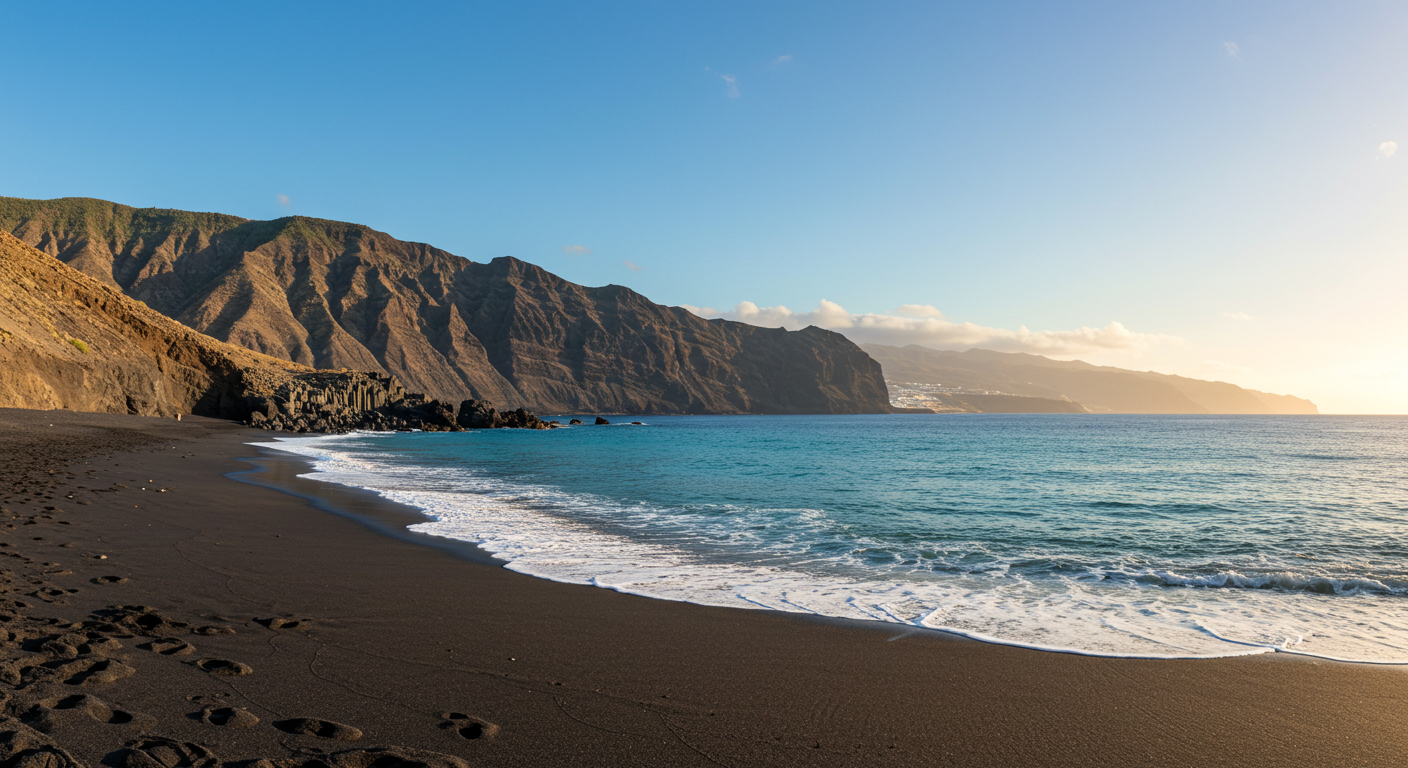
Can You Swim in the Canary Islands in Summer?
Yes — and not just in summer. The Canary Islands sit at roughly the same latitude as the Western Sahara, which means the sea is swimmable every month of the year. In July and August, water temperatures around the southern coasts of Gran Canaria and Tenerife hover between 22°C and 24°C. On the Atlantic-facing northern shores, it's a few degrees cooler and the waves are bigger, which suits surfers more than leisurely swimmers. But the short answer is: if you can get to the Canaries, you can swim. That's true in February and it's true in August.
What surprises most first-timers is that the beaches themselves look nothing like the Mediterranean. No pale limestone grit, no turquoise shallows fading to white. Instead you get black volcanic sand that holds the heat long after sunset, dramatic dunes of wind-blown pale sand imported from the Sahara, and the occasional beach that's entirely red or even greenish. It's genuinely unlike anywhere else in Spain — and that's before you factor in the fact that the islands are technically in the Atlantic, not the Med.
What the Water Is Actually Like in Summer
The Canaries benefit from the cold Canary Current, which runs south from the Iberian coast before warming slightly around the islands. This keeps the water refreshing rather than the bath-temperature soup you sometimes get on the Costa del Sol in August. Southern beaches on Tenerife — Playa de las Américas, Los Cristianos, El Médano — tend to be calmer and a couple of degrees warmer than the north. Gran Canaria's Maspalomas and Playa del Inglés are similar: sheltered, warm enough for hours in the water, and rarely rough.
Lanzarote and Fuerteventura are different propositions. Both islands face the open Atlantic on their western and northern coasts, and the swell can be serious. Fuerteventura in particular is a wind-sports island — Corralejo in the north sees consistent trade winds from June through September, which is fantastic for windsurfing and kite-surfing but less ideal if you want to float about reading a novel. The south of Fuerteventura, around Costa Calma and the Jandía peninsula, is far calmer. Playa de Sotavento, the long, glassy lagoon there, is one of the few beaches in Spain where you can genuinely swim in flat, warm, clear water in the middle of summer without fighting the waves.
El Hierro and La Palma are the odd ones out. Both are small, dramatically volcanic and not set up for mass beach tourism. Swimming in El Hierro tends to mean natural rock pools and the odd small cove — La Restinga in the south is the most popular, surrounded by a marine reserve where the snorkelling is exceptional. If you're after a beach holiday in the traditional sense, El Hierro will frustrate you. If you want to swim among parrotfish and ignore other tourists almost entirely, it's remarkable.
Black Sand Beaches: The Reality
Every travel photo of Tenerife's Playa Jardín or La Palma's Puerto Naos makes the black volcanic sand look impossibly dramatic. It is dramatic. It's also genuinely hot underfoot — far hotter than pale sand — so flip-flops or beach shoes are not optional in July and August. The sand absorbs heat aggressively and doesn't release it quickly. Go barefoot at noon and you'll regret it within about fifteen metres.
Puerto de la Cruz, on Tenerife's north coast, has a cluster of black sand beaches including Playa Jardín, designed by the artist César Manrique. It's well-maintained, has decent shade structures and is far less hectic than the southern resorts. The water here is rougher than the south — this is the Atlantic side — but perfectly swimmable on most summer days. The Lido San Telmo next door is an outdoor seawater pool complex that's useful when the waves pick up.
La Palma's black beaches are quieter still. Puerto Naos is the main one, a long dark crescent with calm water and a low-key resort feel. It was affected by the 2021 Tajogaite volcanic eruption, which sent lava flows across parts of the island, and access to certain areas was restricted for some time afterwards. As of 2026, Puerto Naos is open again, though it's worth checking current local advice before visiting — some of the surrounding areas are still subject to ongoing monitoring.
The Dunes of Maspalomas: A Different Kind of Beach
The dunes at Maspalomas on Gran Canaria's southern tip are the most surreal landscape on the islands. About 400 hectares of pale, Saharan-origin sand — fine, light, almost white — rolling down to a beach that stretches for kilometres. The dunes themselves are a protected nature reserve, which means no sunbeds, no parasols, no infrastructure beyond a small lagoon and a lighthouse at the far end. You walk in, find a spot, and that's it.
The swimming here is good. The sea is calm most of the time, the water is clear, and the beach is wide enough that even in high summer you can find a patch of sand that doesn't feel crowded — though you'll need to walk at least twenty minutes from the Playa del Inglés end to get there. The naturist section, toward the back of the dunes, has been a fixture for decades and is entirely unremarkable to anyone who's spent time on Spanish beaches. Skip the Playa del Inglés resort strip itself; it's functional but charmless. The dunes are the point.
Fuerteventura's Corralejo Dunes: The Other Big Dune System
Corralejo in northern Fuerteventura has its own dune park — smaller than Maspalomas but arguably more photogenic, with the dunes coming right down to the water's edge and the island of Lobos visible offshore. The sea here is not calm. Corralejo is a surf and kite town; the beaches facing northwest get consistent Atlantic swell and wind. Beautiful to look at, more challenging to swim in.
For calm swimming near Corralejo, take the short ferry to Isla de Lobos — a tiny, almost uninhabited island that takes about an hour to walk around. The beaches there are protected from the prevailing swell and the water is extraordinary: clear, shallow, warm. You need to book access in advance (there's a daily visitor limit to protect the environment, usually around 200–300 people per day, though check the current figure with the Cabildo of Fuerteventura before planning your trip).
Year-Round Swimming: When Is the Best Time?
Honestly, the Canaries are as close to a year-round swimming destination as Spain gets. Winter water temperatures rarely drop below 18°C–19°C in the south, which is warmer than a British summer on a good day. The shoulder months — April, May, October, November — are often the best time to visit if you want to swim without the August crowds and the prices that come with them. Air temperatures in October and November are typically 24°C–27°C, the sea is at its warmest after summer, and the resorts are noticeably quieter.
Summer itself — June through September — is peak season, particularly for Spanish and German tourists. Accommodation prices spike. If you're staying for a week in August, book early and expect to pay more than you would in, say, March. As a rough guide, a decent apartment in the south of Tenerife in August 2026 will cost somewhere in the region of €80–€150 per night depending on size and proximity to the beach; the same place in November might be €50–€80. Those are indicative figures — check current listings on Idealista or Airbnb for accuracy.
A Note for Anyone Considering a Longer Stay
The Canaries attract a significant number of remote workers and long-term expats, partly for the weather and partly because the cost of living is genuinely lower than the mainland in several categories — particularly utilities, which benefit from Canarian tax status (the IGIC rate is 7%, versus 21% VAT on the mainland, though this applies to goods and services rather than accommodation directly).
If you're thinking about relocating rather than just visiting, the logistics are broadly the same as the mainland: you'll need a NIE, you'll need to get empadronado, and if you're working remotely for a non-Spanish employer you'll want to look at the Spanish Digital Nomad Visa on Minimum Salary: Is It Worth It? — the Canaries have become a popular base for people on that visa, particularly Las Palmas de Gran Canaria. Setting up a bank account before you arrive makes everything easier; Open a Spanish Bank Account as a Non-Resident in 2026 covers your options there. And if you're planning to work as autónomo, Do You Need a Gestor to Register as Autónomo in Spain? is worth reading before you try to do it yourself.
One thing the Canaries won't solve is the bureaucratic grind of early residency. Appointments are slow everywhere in Spain, and the Canaries are no exception — see Cita Previa Extranjería: How to Get an Appointment When None Exist if you're already fighting that particular battle.
Which Island Should You Actually Go To?
This depends almost entirely on what you want from the water.
For calm, warm swimming with reliable sun: southern Tenerife or Gran Canaria. Both are easy to reach from the UK with direct flights, the infrastructure is solid, and the beaches deliver.
For dramatic volcanic scenery plus decent swimming: Lanzarote. The Playa de Papagayo beaches in the south are genuinely beautiful — small calas with turquoise water and volcanic rock. They're a short drive from Playa Blanca and worth the effort.
For flat-water lagoon swimming and wind sports: Fuerteventura's Jandía peninsula. Sotavento is exceptional.
For snorkelling and almost no other tourists: El Hierro. Accept that it's not a beach holiday island and it becomes one of the most interesting places in Spain.
For black sand and a slightly cooler, greener landscape: La Palma or the north of Tenerife.
The one island I'd skip for a summer swimming trip is La Gomera — not because it's not beautiful, but because it has very few beaches of any size, the ones it does have are mostly dark pebble, and the swell on the west coast can make swimming uncomfortable. It's a hiker's island, not a beach island. Come in spring, walk the laurisilva forest, eat mojo on the terrace of a guachinche and go home happy. But don't come expecting Maspalomas.
The Canaries won't ever look like the Mediterranean, and that's exactly the point.
Frequently asked questions
- Can you swim in the Canary Islands in summer without it being too rough?
- Yes, on the southern and eastern coasts of all the main islands. The sheltered leeward coasts — southern Tenerife, Gran Canaria's Maspalomas, Fuerteventura's Jandía and Lanzarote's Papagayo — have calm water throughout summer. The northern and western coasts face the open Atlantic and can be rough, especially on Fuerteventura and Lanzarote.
- What is the sea temperature in the Canary Islands in July and August?
- Around 22°C–24°C on southern shores in peak summer, and 19°C–21°C on northern Atlantic-facing coasts. The Canary Current keeps the water cooler than the Mediterranean, which most swimmers find refreshing rather than cold.
- Why is the sand black on some Canary Islands beaches?
- The black sand is volcanic in origin — basaltic rock broken down by wave action over thousands of years. It's common on Tenerife (Playa Jardín, Puerto de la Cruz), La Palma (Puerto Naos) and parts of Lanzarote. It absorbs heat much faster than pale sand, so beach shoes are genuinely necessary in summer.
- Are the Maspalomas dunes in Gran Canaria good for swimming?
- Yes. The beach at the base of the Maspalomas dunes has calm, clear water and is one of the better swimming beaches on Gran Canaria. Walk at least 20 minutes from the Playa del Inglés end to find quieter sections. The dunes themselves are a protected nature reserve — no sunbeds or infrastructure inside them.
- Which Canary Island has the calmest beaches for families?
- Southern Gran Canaria (Maspalomas, Playa del Inglés) and southern Tenerife (Los Cristianos, Las Américas) are the calmest and most family-friendly. Fuerteventura's Jandía peninsula is also excellent, particularly around Morro Jable and the Sotavento lagoon. Avoid north-facing beaches on any island if you want flat water.
- Can you swim year-round in the Canary Islands, not just in summer?
- Yes. Water temperatures rarely drop below 18°C–19°C even in January and February. October and November are often considered the sweet spot — warm sea after summer, 24°C–27°C air temperatures, and significantly fewer tourists than August.
- Is it worth visiting Isla de Lobos near Fuerteventura for swimming?
- Absolutely — the shallow, protected beaches on Lobos have some of the clearest water in the archipelago. You need to book access in advance as daily visitor numbers are capped. Take the short ferry from Corralejo and go early. Bring your own food and water; facilities on the island are minimal.