Cáceres and Mérida in Two Days: A Slow Travel Itinerary
A slow travel itinerary for Cáceres and Mérida in Extremadura — two days, realistic pacing, the best medieval and Roman sites, where to eat, and what to skip.
Why Extremadura Keeps Getting Ignored (And Why That's Your Gain)
Most people drive through Extremadura on the way to somewhere else. That's a mistake, and it's one I've made myself — years ago, passing through on the A-5 towards the Algarve, thinking I'd come back properly. When I finally did, I spent four days wandering between two cities that between them cover about 2,000 years of European history, ate extremely well for almost no money, and barely saw another tourist outside of a small cluster near the Roman theatre in Mérida.
A slow travel itinerary for Cáceres and Mérida doesn't need to be complicated. The short answer is this: two full days gives you the essential medieval old city of Cáceres and the Roman monuments of Mérida, with time to actually sit in a plaza and eat lunch properly rather than sprint between sites. If you can stretch to three days, do it — one day per city plus a travel day — but two is workable if you move between them the first morning.
The two cities are about 70 kilometres apart. The bus (run by ALSA) takes roughly an hour and costs around €6–8 each way as of 2026. There's also a train, slower and less frequent, but it exists. Neither city has a major airport, so most people arrive via Madrid (2.5 hours by high-speed train to Cáceres) or by car.
Cáceres First: The Medieval City That Actually Survived
The old city of Cáceres — the Ciudad Monumental — is a UNESCO World Heritage Site, which usually means I brace for crowds and overpriced coffee. Here, the crowds are modest outside of Easter week and high summer, and the coffee is fine. What's genuinely remarkable is the density of intact medieval and Renaissance palaces packed into a few cobbled streets. Fifteen-century towers, stork nests on every rooftop, golden stone that goes amber in the late afternoon. It's the kind of place that makes you slow down just by existing.
Enter through the Arco de la Estrella, the main gate cut through the old walls in the 18th century. From there, the Plaza de Santa María opens up in front of you. The cathedral (technically a co-cathedral, finished in stages from the 13th to the 16th century) is on your left. Go in — it's free or costs a couple of euros depending on when you visit, and it's worth it for the retablos alone.
The palaces around the plaza mostly can't be entered, which is slightly frustrating, but walk the streets behind — Calle Ancha, Calle de los Condes — and you get a sense of the scale. The Casa de los Toledo-Moctezuma is the one with the story: built by a conquistador who married a daughter of the Aztec emperor Moctezuma II. That detail tends to stop people mid-stride.
Where to Eat in Cáceres Without Getting Ripped Off
The restaurants immediately around the Plaza Mayor (just outside the old walls) are hit and miss. The tapas culture here is strong — order a drink and get a free tapa in most bars, which is a tradition that's increasingly rare in more touristy Spanish cities. The Plaza del Duque and the streets off it have a few places that do this properly.
For a proper sit-down lunch, Restaurante Atrio is the famous one — two Michelin stars, serious wine list, prices to match (expect €150+ per person for the full experience). It's extraordinary if you're celebrating something. Otherwise, Torre de Sande in the old city does decent Extremaduran food in a 15th-century palace at more reasonable prices. The local speciality to order is migas extremeñas — breadcrumbs fried with pork fat, garlic, and paprika, usually served with chorizo and fried eggs. Sounds humble, tastes correct.
Ibérico ham from nearby Montánchez, torta del Casar cheese (runny, pungent, extraordinary — ask for it at room temperature), and cordero (lamb) dishes are all things Extremadura does better than almost anywhere else in Spain.
Cáceres Practical Notes
The old city closes to car traffic. Park in the Parking Plaza Mayor (€1.50–2 per hour as of 2026) or in the newer city and walk up. The streets are cobbled and steep in places — comfortable shoes matter more than you'd think.
Monday is a bad day for museums; most are closed. The Museo de Cáceres, which occupies a 16th-century palace and has Roman and medieval collections, is worth an hour if it's open.
If you're thinking about basing yourself here longer — remote workers do, and the cost of living is low even by Spanish standards — the practical paperwork side of things is real. Getting empadronado (registered as a resident) can be done even without a long-term rental contract in some cases; Empadronamiento Without a Rental Contract: Your Real Options is worth reading before you assume you need one. And if you're planning to work remotely from Extremadura, the Spanish Digital Nomad Visa on Minimum Salary: Is It Worth It? piece lays out the income thresholds honestly.
Mérida: Two Thousand Years of History, Modest Entry Fees
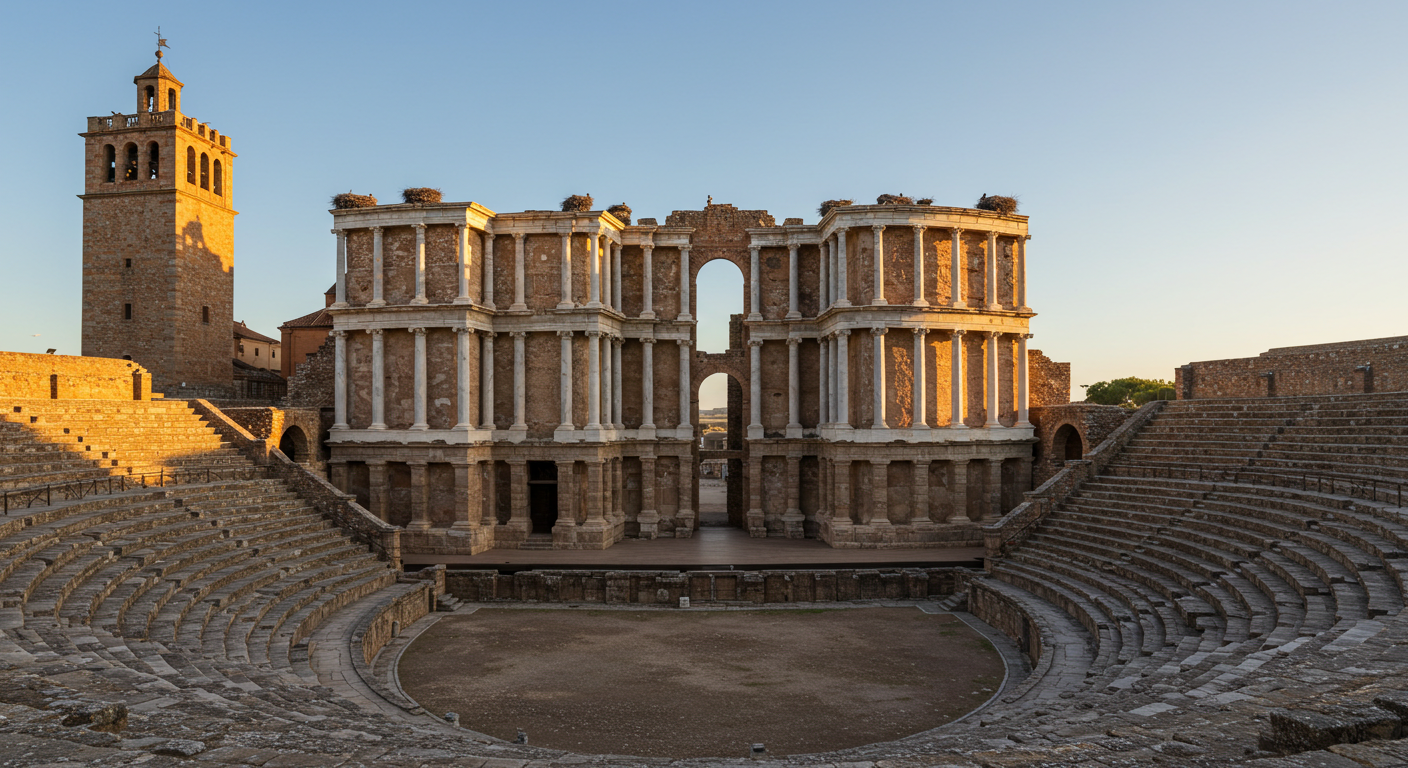
Mérida was Emerita Augusta, the capital of the Roman province of Lusitania. Founded in 25 BC, it became one of the most important cities in the western Roman Empire. What's left is, by Spanish standards, extraordinary: a theatre that seats 6,000 people and is still used for performances, an amphitheatre, a circus, two Roman bridges, an aqueduct, and a museum that's one of the best in Spain for Roman artefacts.
The Teatro Romano is the centrepiece and it earns it. The stage backdrop — two tiers of marble columns, statues in the niches — is the kind of thing that makes you stop and stare for longer than you planned. It's been heavily restored, which some people find off-putting, but the scale and the setting are still arresting. The combined ticket (teatro, amphitheatre, circus, Alcazaba, and a couple of other sites) costs around €15 as of 2026 and is valid for two days, which is sensible.
The Museo Nacional de Arte Romano, designed by Rafael Moneo and opened in 1986, is one of the finest buildings in Extremadura and one of the best Roman museums in Europe. The collection is vast — mosaics, sculpture, jewellery, everyday objects — and the building itself, all brick arches and natural light, gives you the feeling of being inside a Roman structure rather than looking at Roman things through glass cases. Allow two hours minimum. It's closed Mondays.
The Roman Bridge and the Alcazaba
The Puente Romano crosses the Guadiana river on 60 granite arches. It's 792 metres long, which makes it one of the longest surviving Roman bridges in the world. You can walk across it. The other side has a small viewpoint and not much else, but the walk itself — looking back at the bridge and the Alcazaba behind it — is the point.
The Alcazaba is a Moorish fortress built in the 9th century, partly using Roman materials (you can see column drums recycled into the walls). It sits directly on the river. The views from the top are good and the interior has a Roman cistern you can descend into.
Mérida's Festival Season
The Festival Internacional de Teatro Clásico runs every July and August, using the Roman theatre as its stage. Greek tragedy and Roman comedy performed where they were always meant to be performed. Tickets sell out for the popular nights, so book ahead if you're planning around it. Prices range from around €15 to €35 depending on production and seat.
Where to Stay and Eat in Mérida
Mérida is smaller than Cáceres and quieter at night. The Parador de Mérida occupies an 18th-century convent near the temple of Diana — it's one of the better Paradores in Spain, with a pool and a decent restaurant, and prices are more reasonable than the Madrid or Granada Paradores (around €100–140 per night depending on season as of 2026). Worth it for a night.
For food, the area around Plaza de España has the usual mix. Restaurante Rex Numitor, close to the Roman theatre, is reliable for Extremaduran classics without being overpriced. The torta del Casar appears again here. Order it.
The Slow Travel Itinerary: How to Structure Two Days
Day one works best as a Cáceres day. Arrive in the morning — the 7:30 or 8:00 train from Madrid Chamartín gets you there by mid-morning. Drop bags (most hotels will hold them), walk the old city before the midday heat, have a long lunch, then explore the lower streets and the Plaza Mayor in the late afternoon when the light is right. Evening drink in the old city; dinner late, as Spain intends.
Day two, take the early bus or train to Mérida. The ALSA bus at around 9:00 gets you there before 10:00. Buy the combined ticket and go to the theatre first, before the tour groups arrive. Museum in the middle of the day when it's too hot to be outside. Bridge walk in the late afternoon. Dinner in Mérida, then either stay the night or take an evening bus back towards Madrid or wherever you're headed.
If you have a third day, split your time differently: stay two nights in each city, visit the Parque Natural de Monfragüe (an hour north of Cáceres by car, extraordinary for birdwatching — black vultures, Spanish imperial eagles, black storks) or the medieval town of Trujillo, birthplace of Francisco Pizarro, which is another 45 minutes east of Cáceres and takes half a day.
The Practical Bit: Getting Here and Getting Set Up
Renfe's high-speed service from Madrid Atocha to Cáceres takes around 2.5 hours and costs €25–45 depending on how far ahead you book. The station is walkable from the city centre. For Mérida from Madrid, there's a direct service but it's slower; most people go via Cáceres.
If you're considering a longer stay in Extremadura — and the cost of living is genuinely low, rents in Cáceres city centre run €400–600 for a decent flat as of 2026 — the usual admin trail applies. Renting in Spain Without a Spanish Payslip: How Foreigners Do It covers the landlord negotiation side. And if you're setting up as self-employed, Do You Need a Gestor to Register as Autónomo in Spain? is worth reading before you try to navigate the Hacienda paperwork alone.
Healthcare is worth sorting before you arrive properly. Healthcare in Spain Before Your TIE Arrives: What Cover Do You Actually Have? explains the gap period honestly.
Extremadura won't suit everyone. It's quiet, rural-feeling even in the cities, and the nightlife is not Madrid. But if you want to walk Roman streets in near-solitude, eat some of the best cured pork and cheese in Europe, and spend under €100 a day comfortably including a decent hotel, it's one of the more underrated corners of the country.
The storks will be nesting on the towers when you get there. That's worth something.
Frequently asked questions
- How long do I need for a slow travel visit to Cáceres and Mérida?
- Two full days is the realistic minimum — one focused on Cáceres's medieval old city, one on Mérida's Roman monuments. Three days is better: it lets you pace yourself properly, eat lunch slowly, and visit one or two places nearby like Trujillo or Monfragüe without feeling rushed.
- What's the best way to travel between Cáceres and Mérida?
- The ALSA bus is the most practical option — roughly one hour, €6–8 each way as of 2026, and runs several times a day. There's also a train service but it's less frequent. By car takes about 45 minutes on the A-66 motorway.
- Is Mérida's Roman theatre worth visiting?
- Yes, unambiguously. The combined ticket (around €15 as of 2026) covers the theatre, amphitheatre, circus, and several other sites and is valid for two days. The Museo Nacional de Arte Romano is equally worth your time — allow at least two hours and note it's closed Mondays.
- What food should I eat in Extremadura?
- Torta del Casar (a runny, pungent sheep's milk cheese — ask for it at room temperature), Ibérico ham from Montánchez, migas extremeñas (fried breadcrumbs with pork and paprika), and lamb dishes. These are all things Extremadura does at a very high level and at prices well below what you'd pay in Madrid or Seville.
- Is Extremadura worth visiting outside of summer?
- Spring (March to May) is arguably the best time — mild temperatures, wildflowers on the dehesa landscape, and fewer visitors than summer. Autumn is also good. Summer can be brutally hot (40°C+ in July and August in Mérida is not unusual), though the Roman Theatre festival runs precisely then if that's a draw.
- Can I visit Cáceres and Mérida as a day trip from Madrid?
- Technically yes for one city — the train from Madrid to Cáceres takes about 2.5 hours — but doing both as a day trip is too rushed to be enjoyable. An overnight in at least one city makes the trip feel like an actual visit rather than a sprint.
- Is Extremadura a good place to live as a remote worker or digital nomad?
- It can be, especially on a budget. Cáceres has rents around €400–600 per month for a decent flat as of 2026, good food, and a functioning small-city infrastructure. The main trade-off is limited English-speaking expat community and fewer direct transport links than the big cities. If you're applying for a Spanish Digital Nomad Visa, check the income requirements carefully — the visa has a minimum salary threshold that catches some people out.